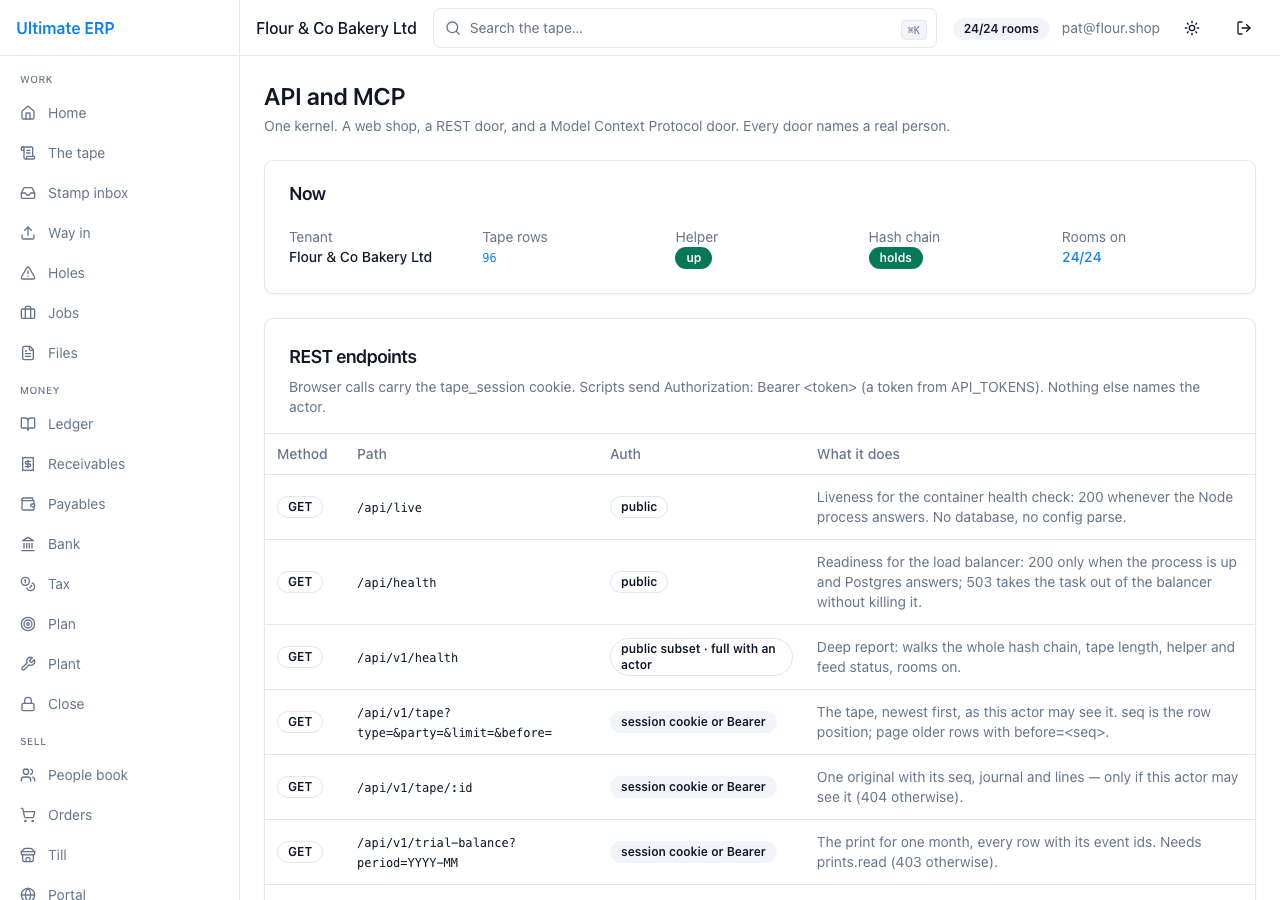
Stage 2: go deeper in seven sessions

Seven sessions of 45 to 60 minutes. Go deeper: the rules behind each door, and a drill in every session where you do the wrong thing on purpose. Your ticks save here, under your name, so you can pick up on any device.

Who is training?

Type your name to start your own path, or resume with the code you were given. One name covers both courses.

The team

Everyone's path, one row each. Both courses, side by side. Names and counts only.

Nobody has started yet. Be the first.

Pick a name above to turn on the tick boxes. You can read everything without one.

Session 1 · The law rooms, close up0/30 steps

55 minutesLog in as pat, and as kai for the second pair of hands
Today's goal: learn the four rules that hold the money book steady: who may stamp, two hands, the close calendar, and reverse never erase.

Before you start (3 min)

This course sits beside the 7-day one. Do that one first. Here we open the same doors and look at the rules behind them.

Go to tape.rightweb.app/login. Tick Start fresh before you log in. That puts the demo shop back to the same rows the pictures were taken from. Without it, other people's work is still there and your numbers will look different.

Two words you will use all week. A draft is a suggestion nobody has agreed to. A stamp is a named person saying yes. Only a stamp moves money.

1.1 Read the approval bands10 min
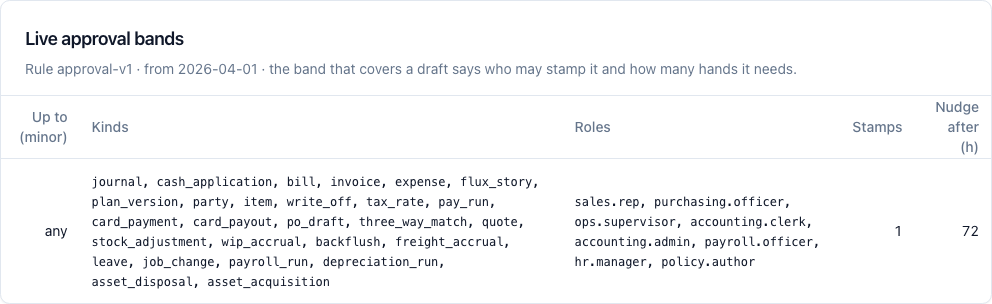
The live approval band. It says which drafts it covers, who may stamp them, and how many hands are needed.
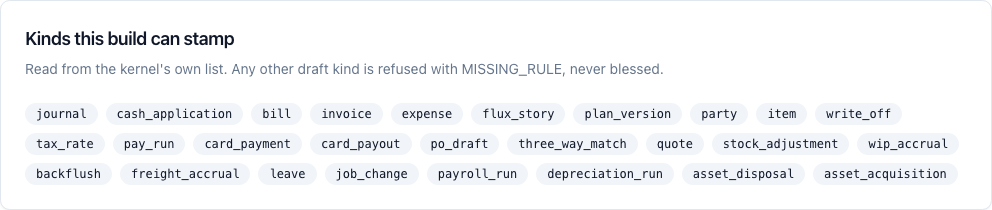
The 27 draft kinds this build can stamp. Any other kind is refused.
You should see: a band that covers every kind, needs one stamp, and names eight roles.
Why it matters: the band is a published rule, not code. A shop that wants two stamps over $5,000 publishes a new version. Nobody edits the old one.

1.2 Two hands on a stamp10 min

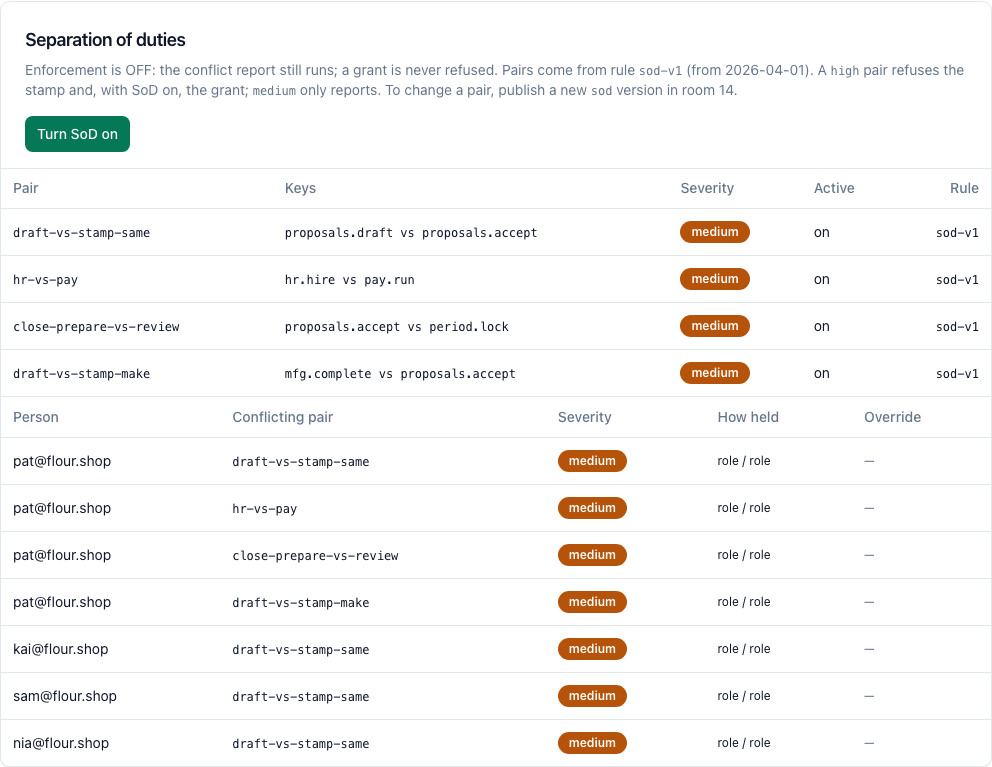
The duty pairs. Each pair is two keys one person should not hold at the same time.
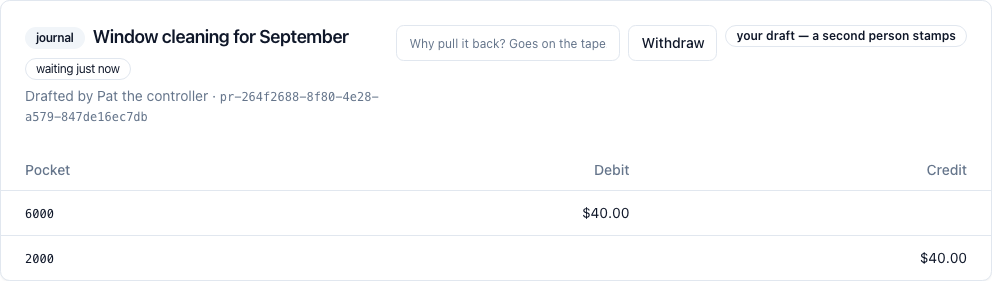
Your own draft with two hands on. There is no Stamp button, only Withdraw.
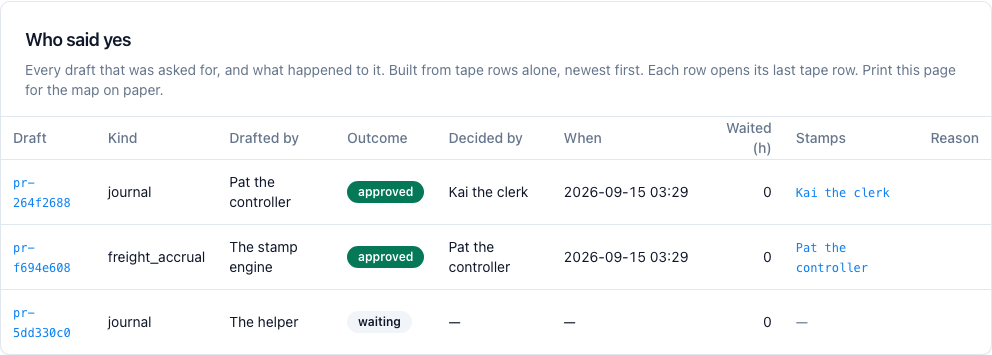
Who said yes. Drafted by one person, decided by another, both on the tape.
You should see: the draft leaves pat's inbox. In Policy, under Who said yes, the row says drafted by Pat and decided by Kai.
Why it matters: one person writing and stamping the same row is how money walks out of a shop. Two hands is a rule, not a habit.

1.3 The close calendar and the close pack12 min
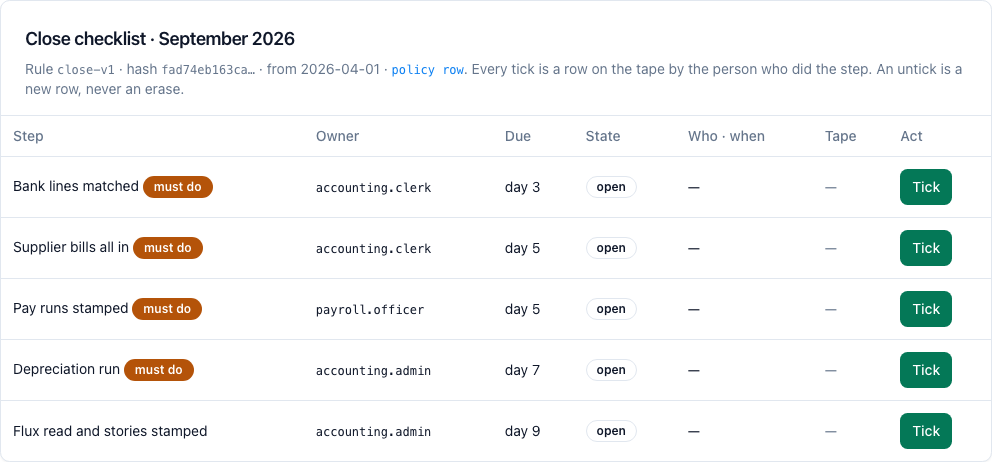
The close checklist. Each step has an owner role and a day it is due.
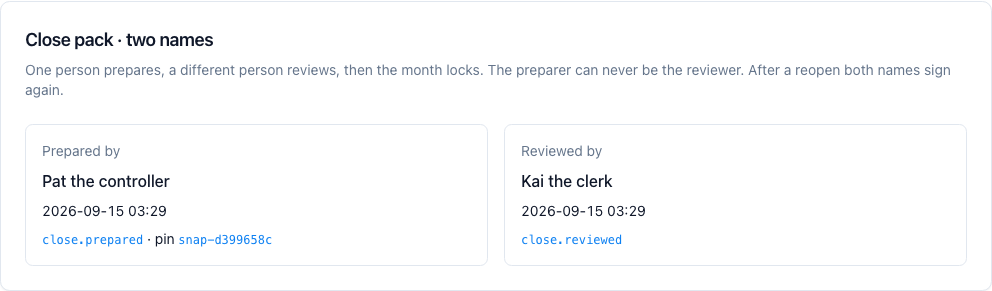
Two names on the close: one prepared, a different one reviewed.
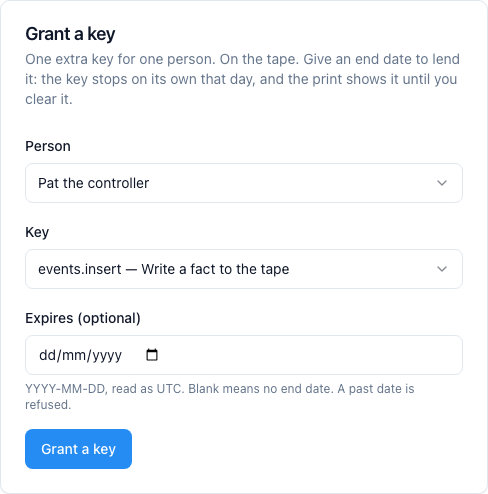
One extra key for one person, with an end date if you are lending it.
You should see: two different names on the close pack, each with its own tape row.
Why it matters: the close pack is what you hand the accountant. It is built from the tape when you ask for it, so it can never drift from the facts.

1.4 Drill: review your own work6 minrefusal drill

Do the wrong thing on purpose. Read the refusal, and write down the words it used.
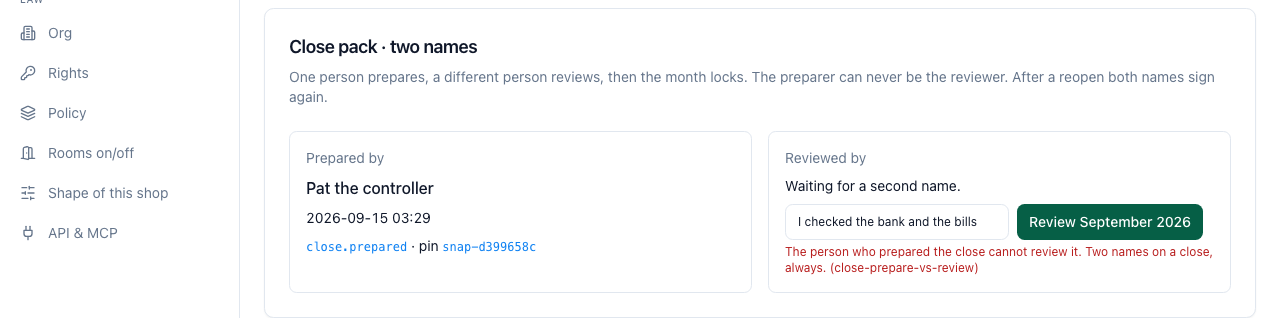
The refusal names the pair: close-prepare-vs-review.
You should see: "The person who prepared the close cannot review it. Two names on a close, always. (close-prepare-vs-review)"
Why it matters: the refusal names the rule it comes from. You never have to guess why a door said no.

1.5 Drill: lock a month out of turn6 minrefusal drill

Do the wrong thing on purpose. Read the refusal, and write down the words it used.

September will not lock while July is still open.
You should see: "Lock 2026-07 first. Months lock oldest first, in order."
Why it matters: a book that can be locked out of turn has holes in the middle. The rule is boring on purpose.

1.6 Reverse, never erase, and the chain10 min
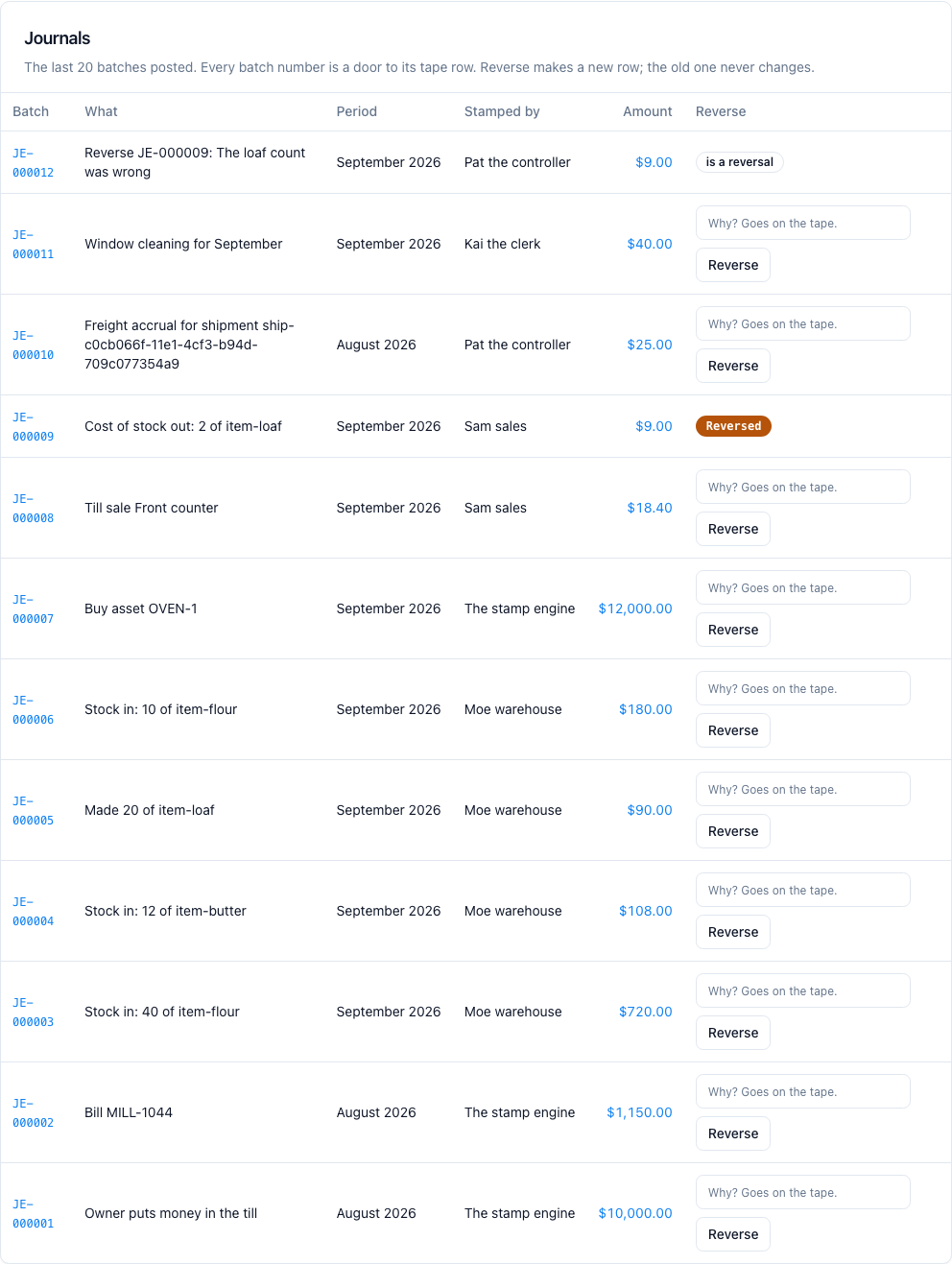
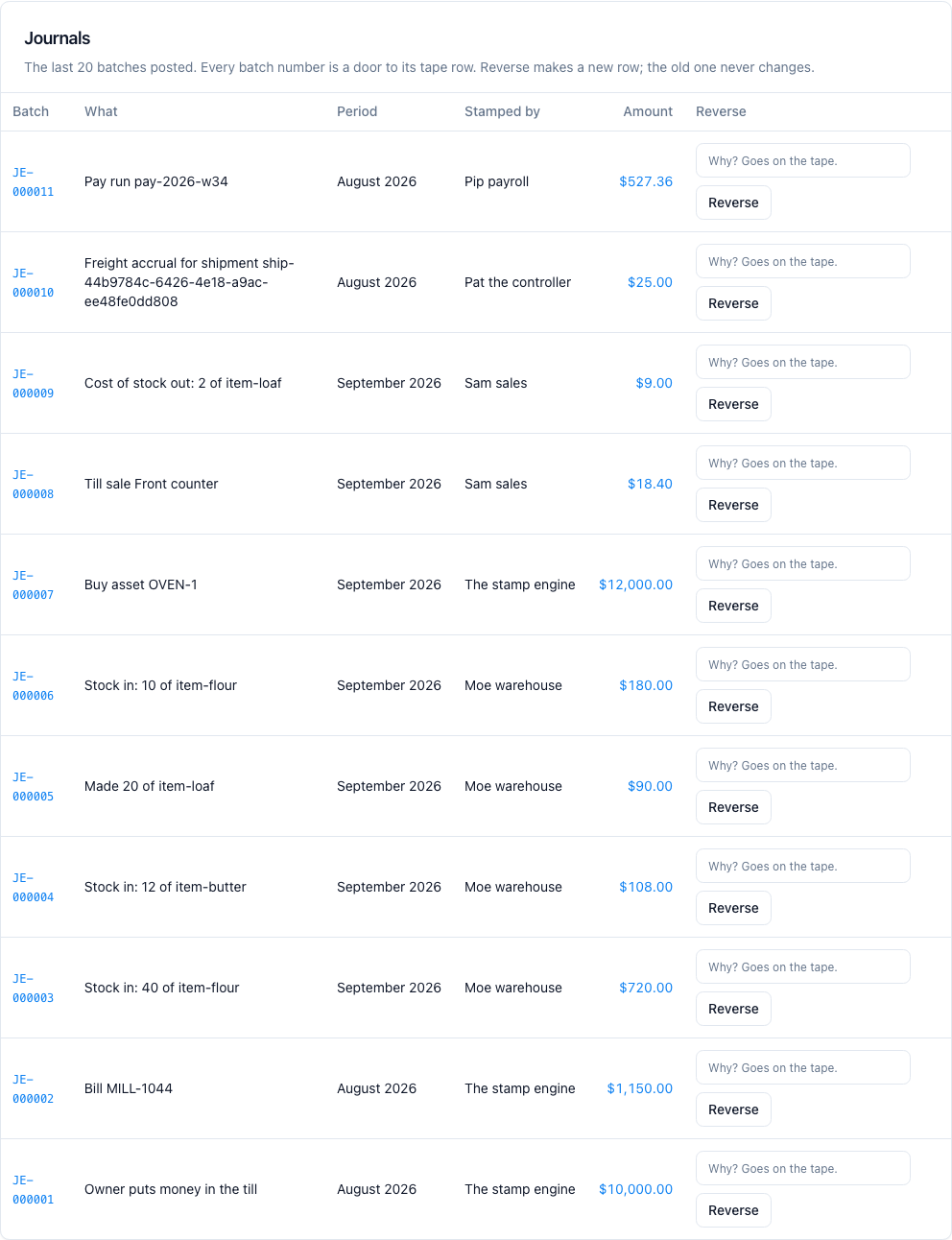
The batch list. The old row keeps its amount and a new row sits beside it.
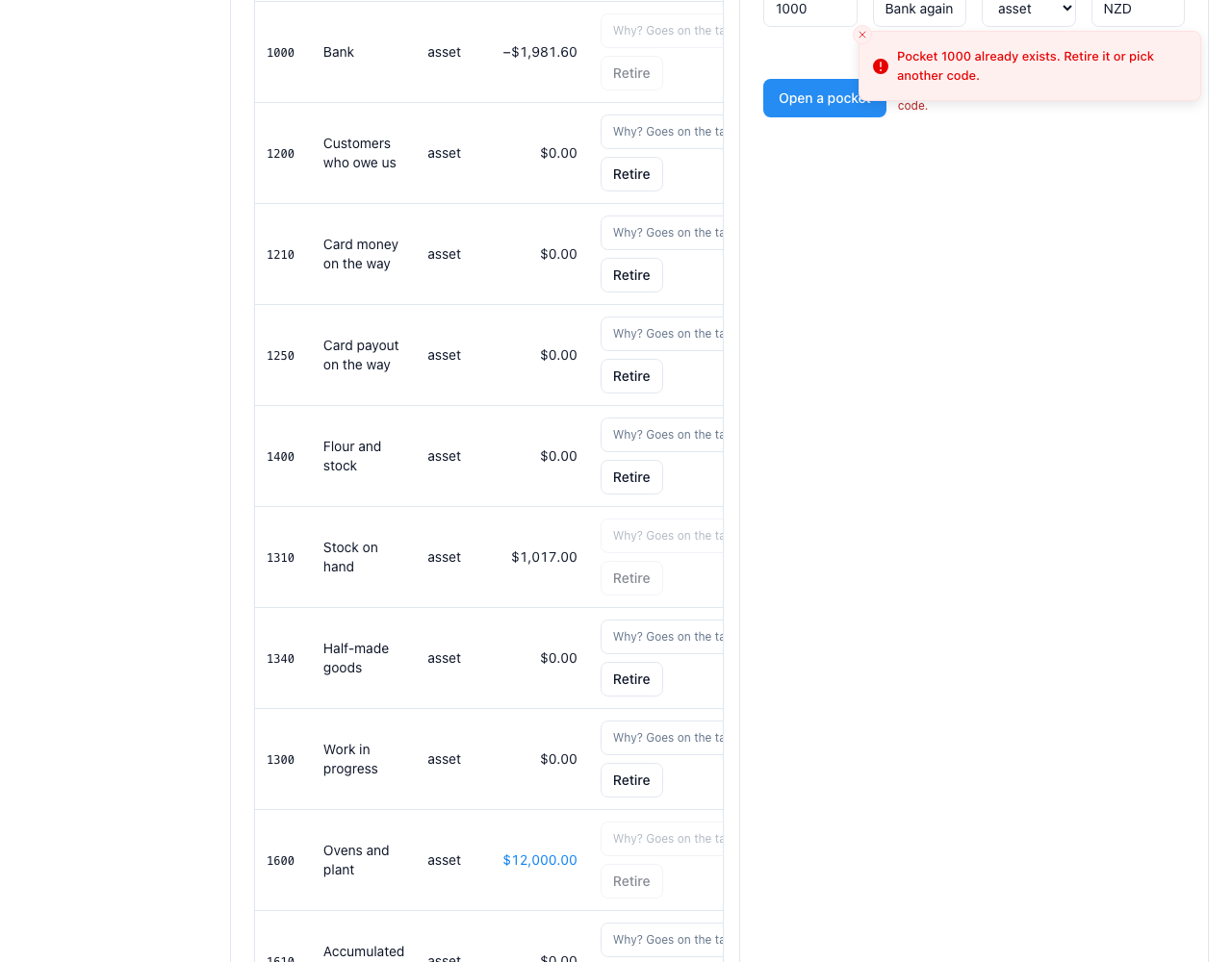
A pocket code that is already on the chart is refused.
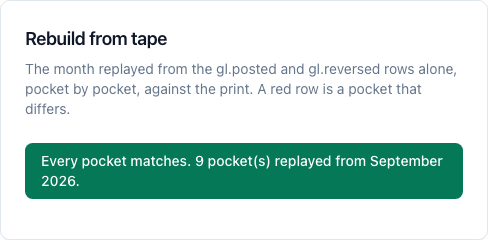
The month replayed from the tape alone, pocket by pocket, against the print.
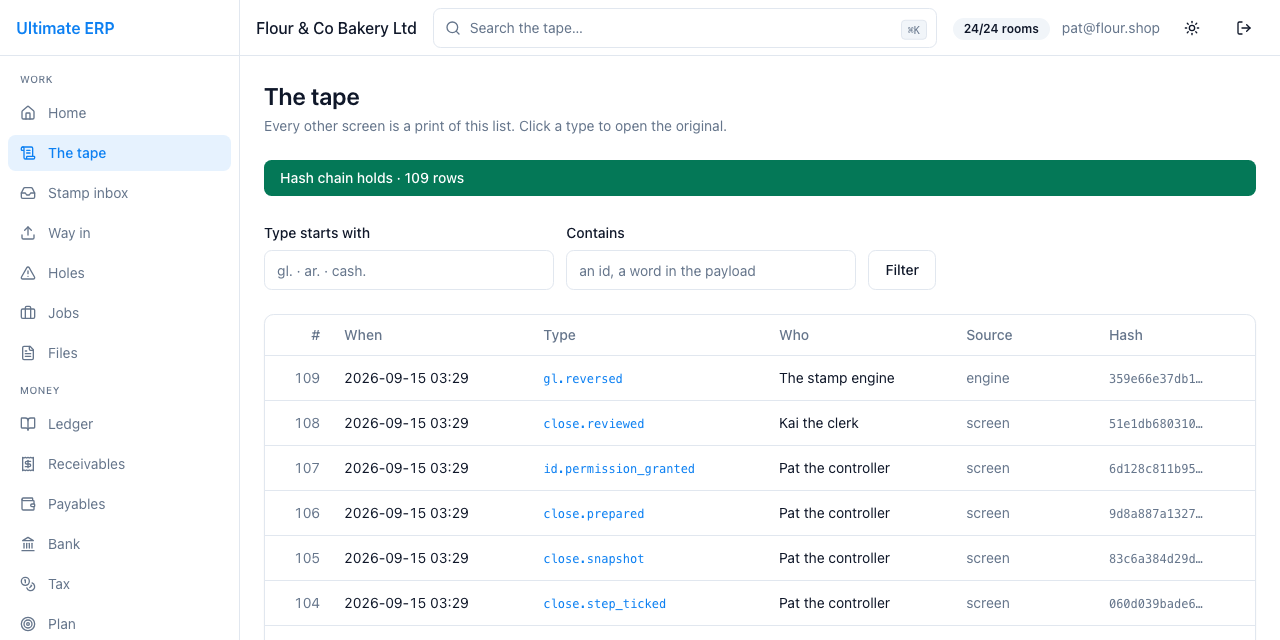
The tape, with the green banner: the hash chain holds.
You should see: "Pocket 1000 already exists. Retire it or pick another code." and "Every pocket matches."
Why it matters: an erase hides a mistake. A reversal shows the mistake and the fix, both for ever. That is what an auditor is looking for.

Check yourself

Who decides whether you may stamp a $9,000 bill?
The published approval band live on that day. It names the kinds, the amount ceiling, the roles and how many stamps are needed.
Two hands is on. You drafted a journal. What does the inbox show you?
Your own draft with no Stamp button, and the words "your draft, a second person stamps". You can withdraw it, not stamp it.
The close pack needs two names. Who can be the second one?
Anyone holding the period.lock key who did not prepare it. In the demo you grant that key to Kai first.
Why will September not lock while July is open?
Months lock oldest first, in order. A book with a locked month after an open one has a hole in the middle.
You reversed a journal. What happened to the first row?
Nothing. It keeps its amount for ever. A new, opposite row sits beside it.
What does "Rebuild from tape" prove?
That the month's print can be made again from the tape rows alone, pocket by pocket. If a pocket differed it would show red.

Session 2 · Money in and money out, end to end0/29 steps

60 minutesLog in as pat
Today's goal: take one sale from order to invoice to dispute to credit, hold a supplier bill, try to pay it anyway, and prove the cash.

The shape of this session (3 min)

Money in lives in Receivables. Money out lives in Payables. The bank sits between them in Bank, and Tax reads what both of them did.

Watch for one habit all session: nothing here types a date or a pocket by hand. The due date comes from a published terms rule. The pockets come from a published coding rule. A missing rule refuses.

2.1 An order becomes an invoice10 min
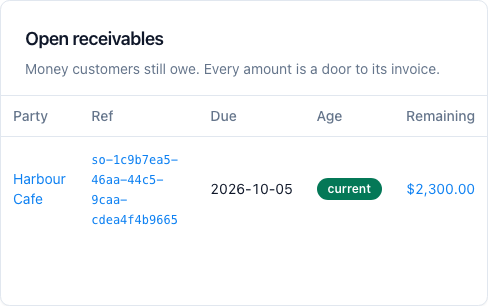
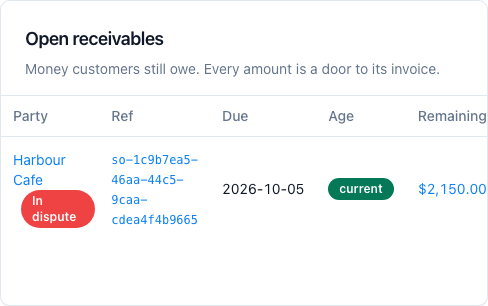
Open receivables. The due date came from the published payment terms.
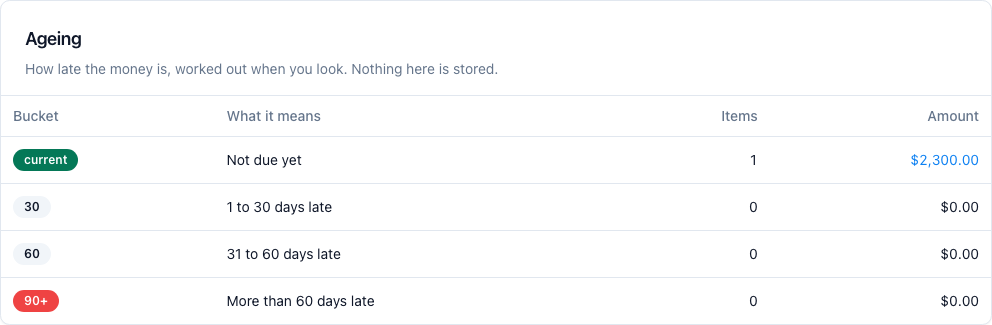
Ageing. Worked out when you look. No bucket total is stored.
You should see: one open item for Harbour Cafe, sitting in the "current" bucket.
Why it matters: the due date comes from the rule NZ-20TH-v1. Change the rule and every new invoice changes. Old ones keep the date they were given.

2.2 A dispute, then a credit note12 min
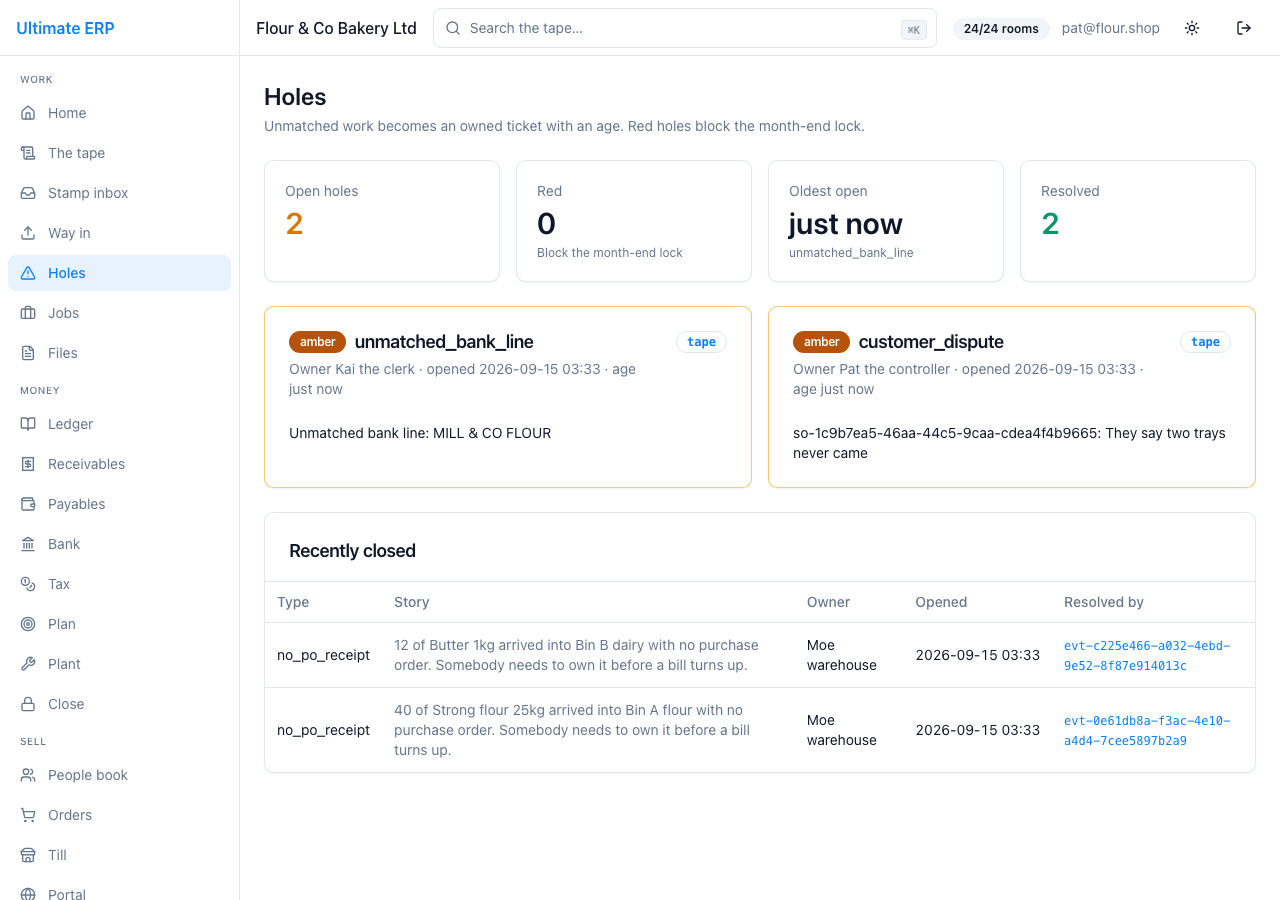
The dispute opened a hole with an owner and an age.
After the credit note the open amount is smaller. The first invoice row is unchanged.
You should see: the invoice open amount drops by the credit, and the original invoice row is untouched.
Why it matters: a dispute is a fact, not a number change. It makes the open list stop looking healthy so somebody chases it.

2.3 Drill: the same supplier bill twice6 minrefusal drill

Do the wrong thing on purpose. Read the refusal, and write down the words it used.

The second bill with the same reference and date is refused by name.
You should see: "Bill MILL-2001 dated 2026-09-15 already exists for this supplier."
Why it matters: paying the same bill twice is the most common way a shop loses money. The key is supplier plus tidied reference plus invoice date, so "MILL 2001" cannot slip past "MILL-2001".

2.4 Drill: pay a bill that is on hold10 minrefusal drill

Do the wrong thing on purpose. Read the refusal, and write down the words it used.

The held bill. It stays in the ageing print, marked, never hidden.
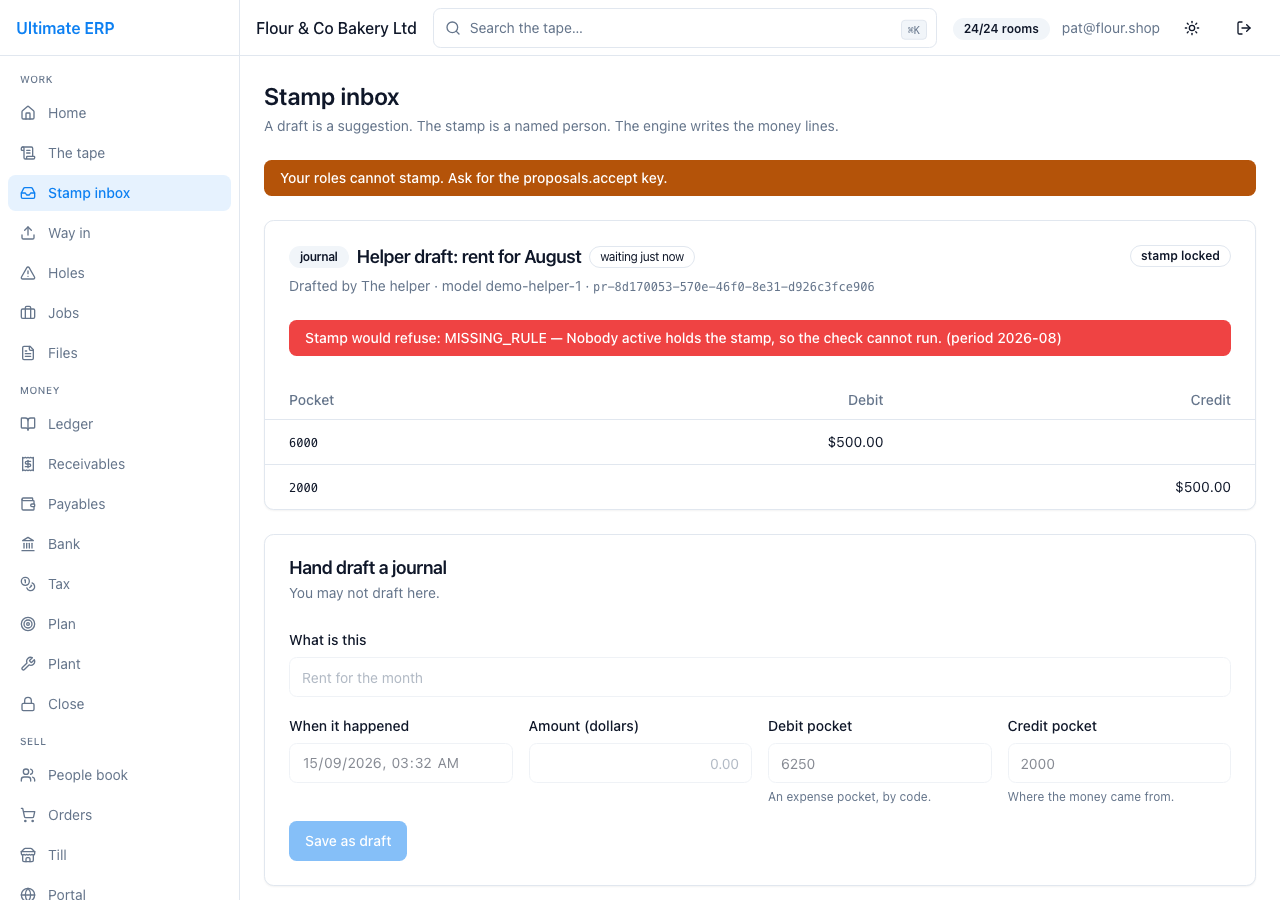
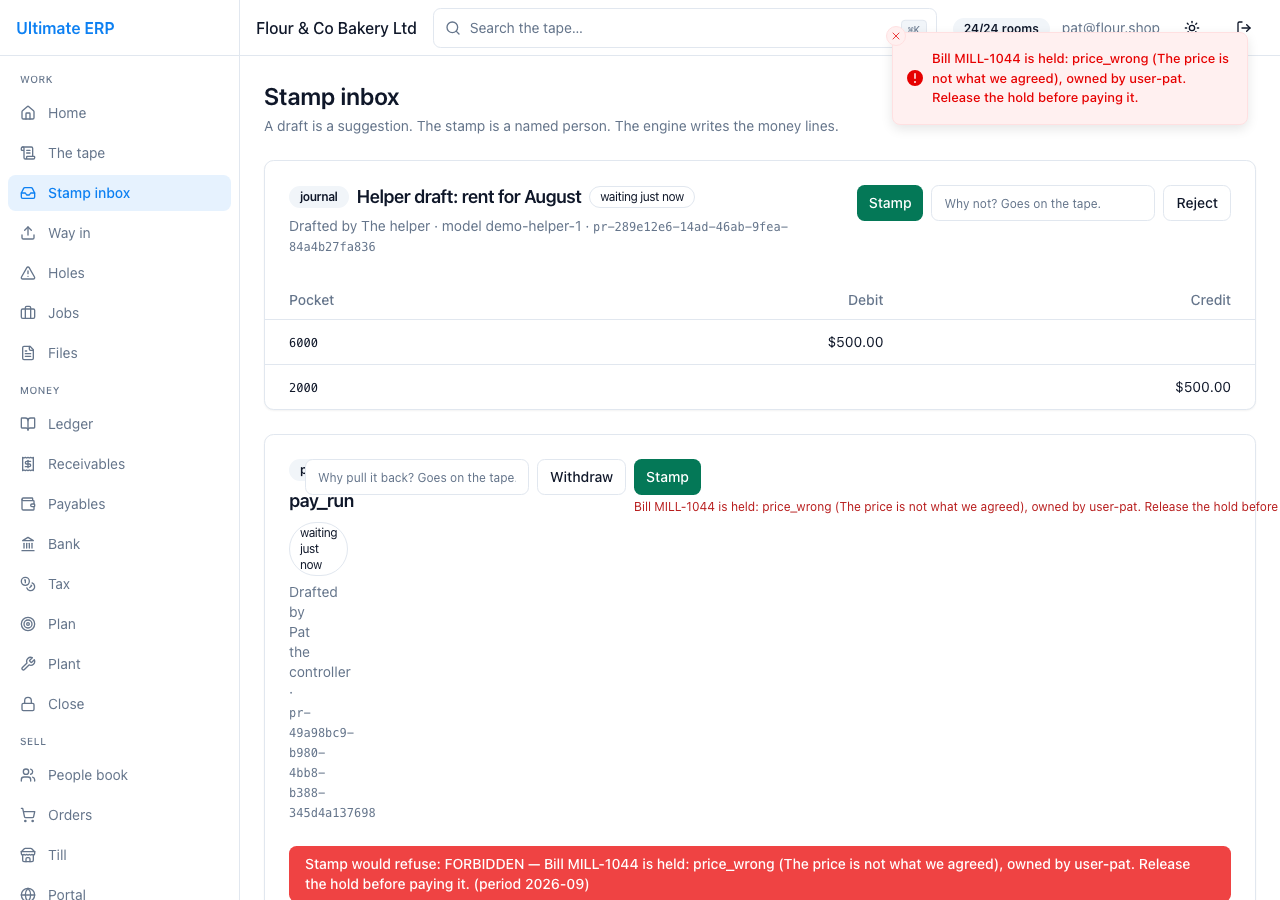
The inbox says the stamp would refuse before you press it, and says so again when you do.
You should see: "Bill MILL-1044 is held: price_wrong (The price is not what we agreed), owned by user-pat. Release the hold before paying it."
Why it matters: the draft is cheap and the stamp is the gate. The inbox even tells you the stamp would refuse before you press, so nobody wastes a trip.

2.5 Two hands on bank details8 min

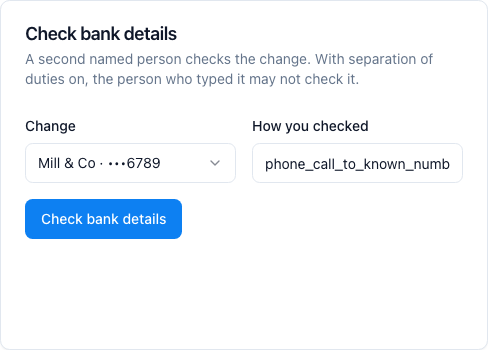
A change to a supplier's bank details waits for a second named person.
You should see: the supplier named in the "waiting on a check" banner, and a masked account like •••6789 on the row.
Why it matters: the most expensive fraud is a changed bank number on a real supplier. Two people and a masked number is the cheap defence.

2.6 Prove the cash, then drop the feed12 min

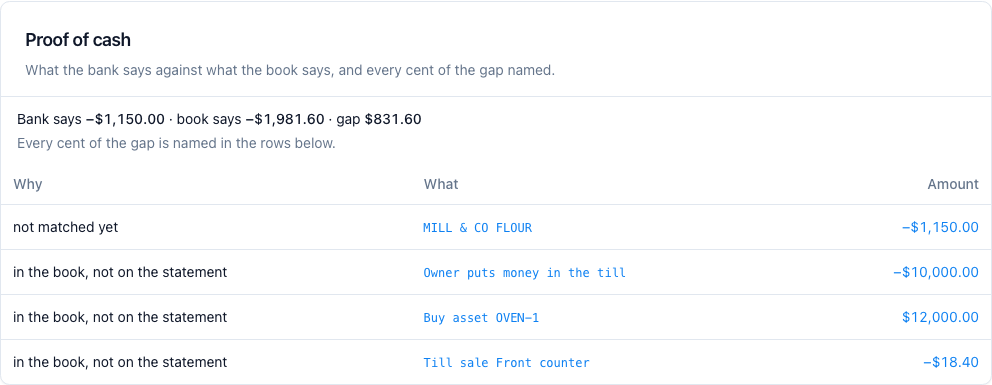
Proof of cash. Every cent of the gap between the bank and the book is named.
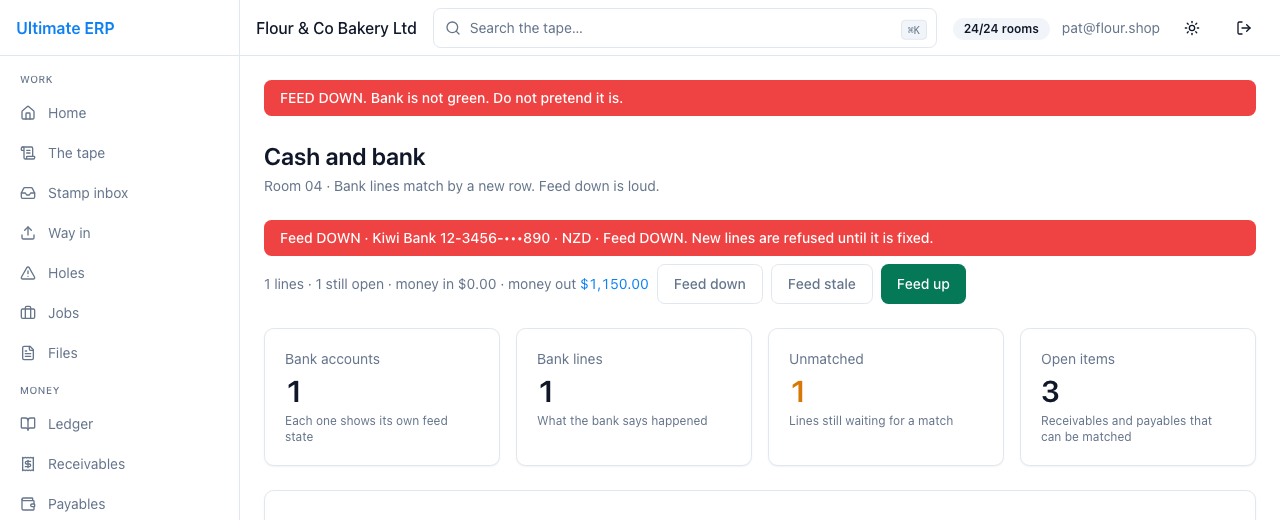
Feed down. The banner is loud and new lines are refused.
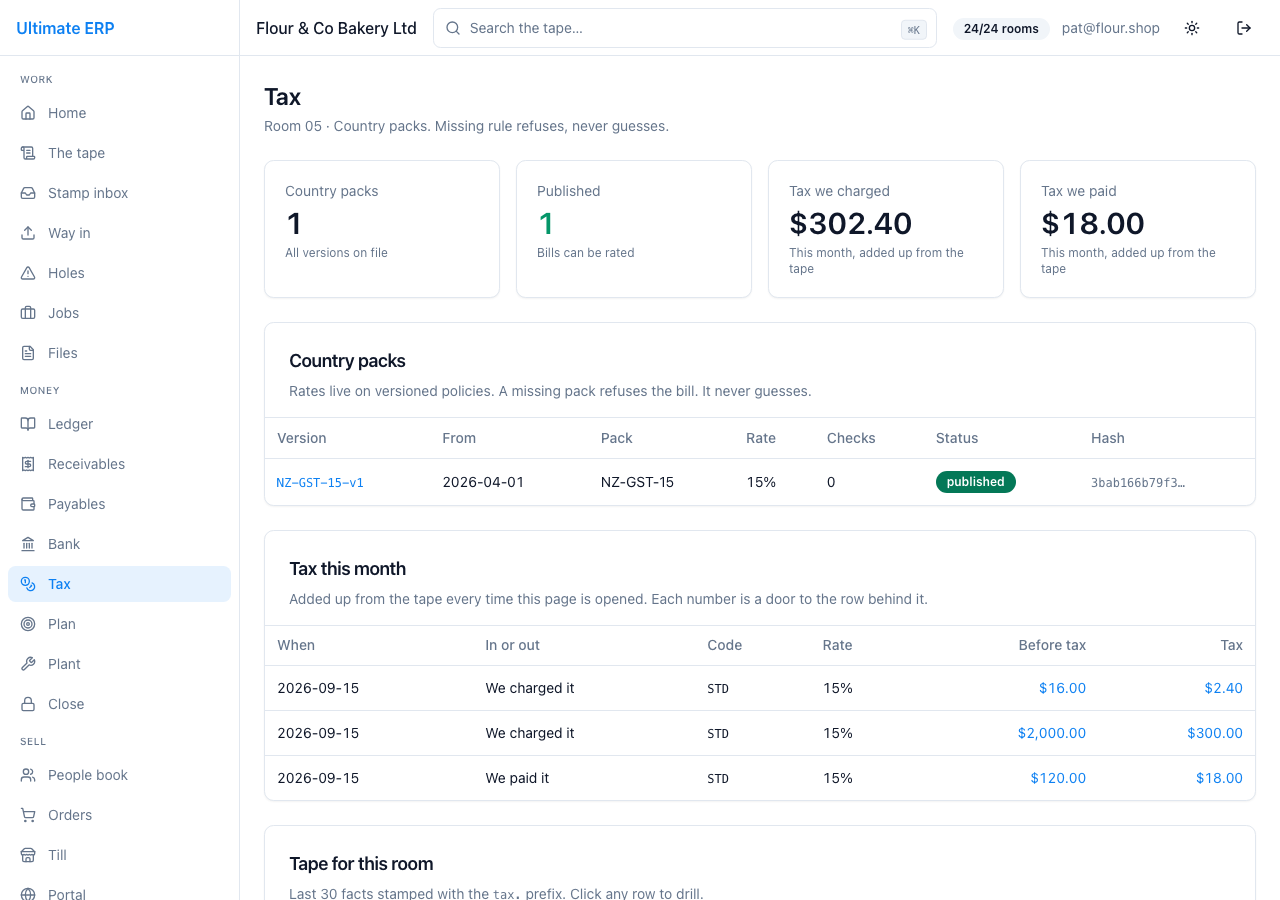
Tax this month, added up from the tape when you open the page.
The bank line after the match. Nothing was edited; a new row settled it.
You should see: "Feed DOWN. New lines are refused until it is fixed." and a tax table where each amount is a link.
Why it matters: a bank feed that dies quietly is worse than one that dies loudly. A red banner is a feature.

Check yourself

Where does an invoice due date come from?
The published payment terms rule live on the invoice date. Nobody types it.
A customer says a bill is wrong. What should you do first?
Raise a dispute. It moves no money, opens a hole with your name on it, and stops the open list looking healthy.
Does a credit note change the invoice?
No. The invoice keeps its amount for ever. The credit note is a new row pointing at it, and the open amount is worked out from both.
Why was the second MILL-2001 bill refused?
The key is supplier plus tidied reference plus invoice date. The same three means the same bill.
You can draft a payment run for a held bill. Why?
A draft is only a suggestion. The check runs at the stamp, and the inbox warns you before you press.
What is proof of cash?
The bank balance against the book balance, with every cent of the difference named by a reason and a row.

Session 3 · Sell it, buy it, make it, ring it0/32 steps

60 minutesLog in as pat
Today's goal: walk one sale from a quote to a shipped parcel, raise a purchase order, count a shelf, and ring the till with two kinds of money.

Four different facts (3 min)

A quote is a price that is good until a day. An order is a promise to buy. A shipment is goods leaving. An invoice is a demand for money. They are four facts, not four names for one.

Every one of them is a separate row on the tape, and only the last one moves money.

3.1 Quote, order, ship, invoice14 min

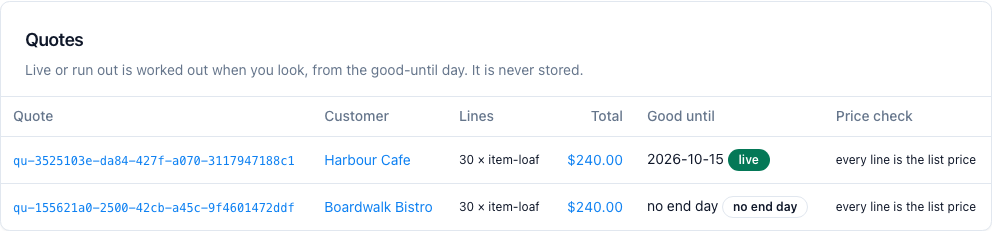
Quotes. Live or run out is worked out when you look, from the good-until day.
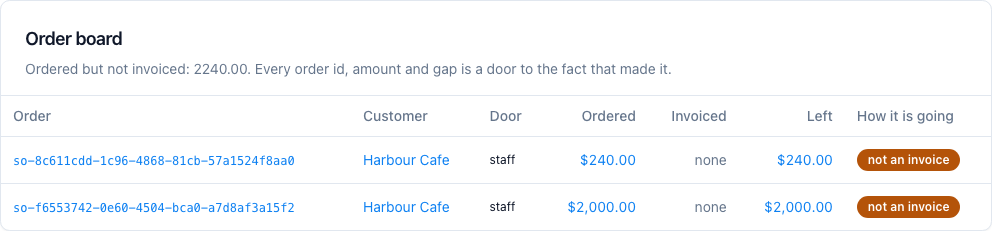
The order board. Every id and amount is a door to the fact that made it.
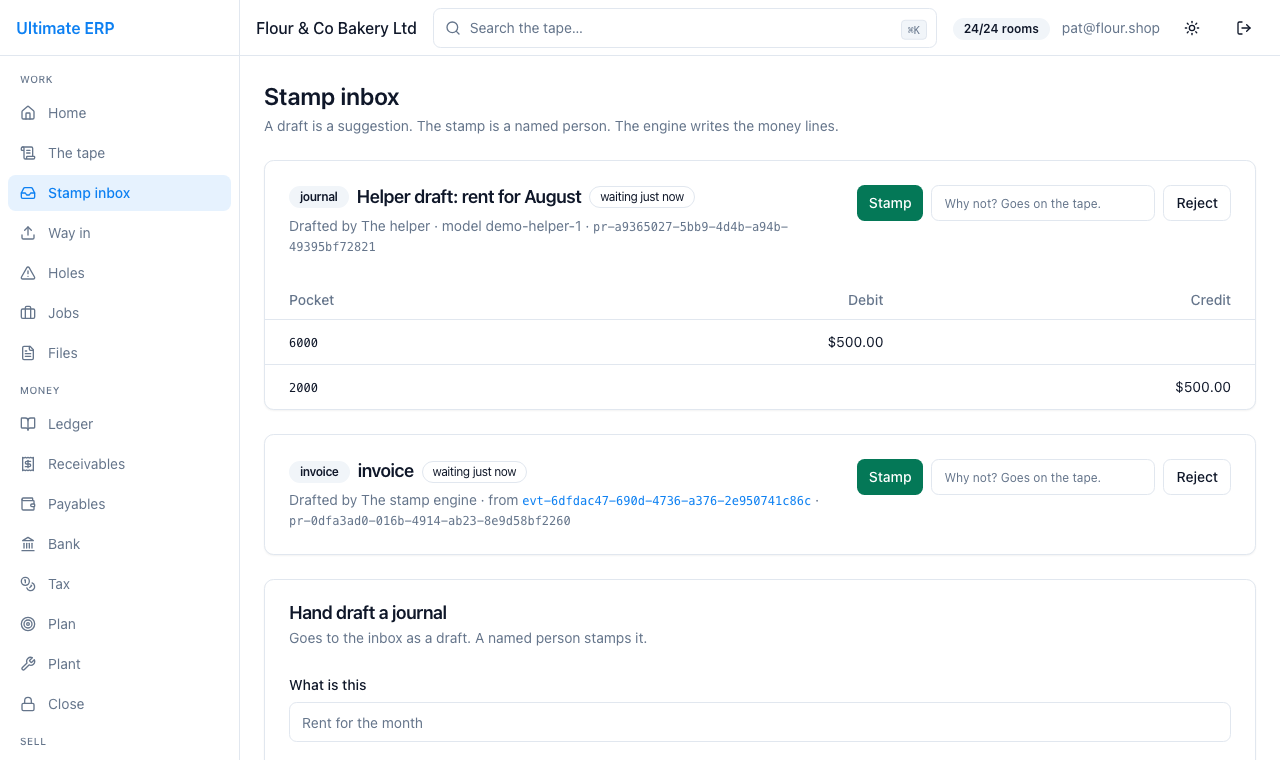
Shipping drafted the invoice. It waits in the stamp inbox for a named person.
You should see: an invoice draft in the inbox that you did not write, with the order behind it.
Why it matters: the floor should never be able to post money. It writes a fact, the fact drafts the money, and a named person in the money room stamps it.

3.2 Drill: hold more stock than there is8 minrefusal drill

Do the wrong thing on purpose. Read the refusal, and write down the words it used.
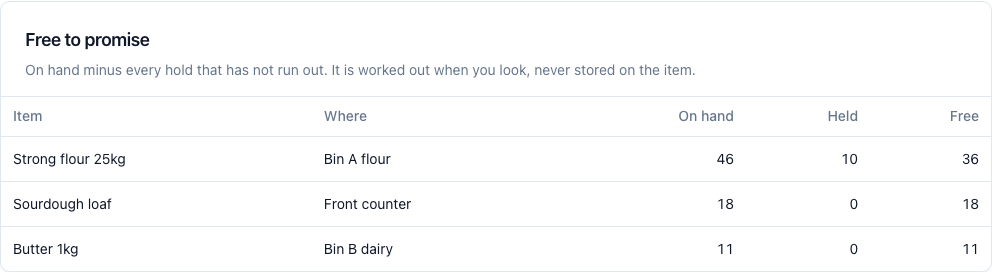
Free to promise is worked out when you ask. A hold over it is refused, never guessed.
On hand, held, and free. The free number is never stored on the item.
You should see: "46 free, 9999 asked. Refused, not guessed."
Why it matters: free to promise is a question, not a stored number. Storing it is how two salespeople sell the same bag.

3.3 Buy: an order, a receipt, and goods with no order10 min

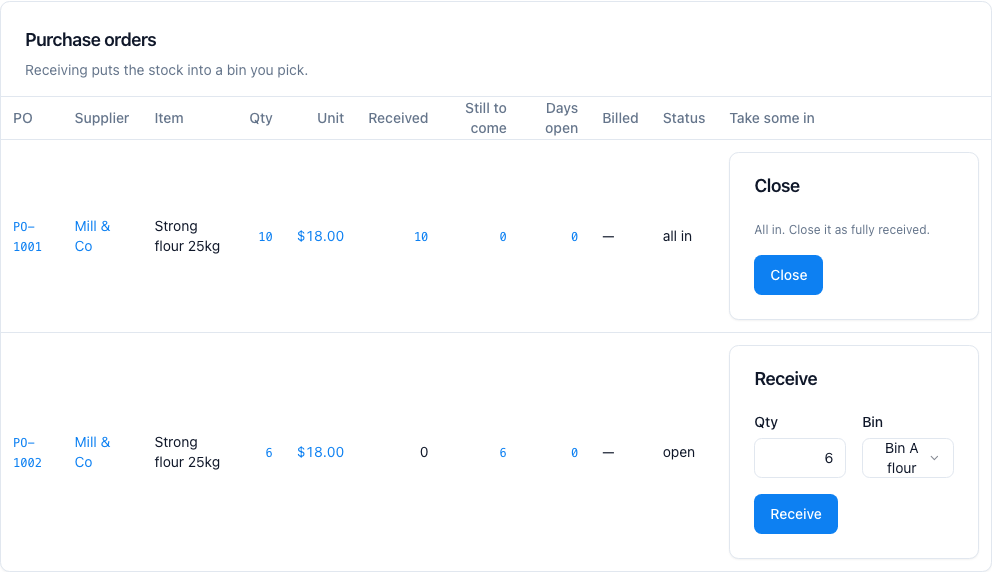
Purchase orders, with what is still to come and how many days it has been open.
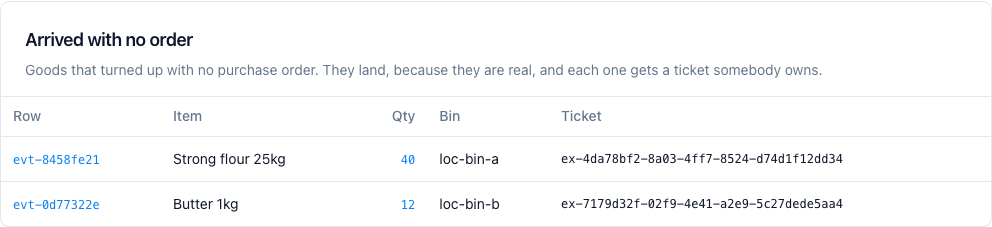
Goods that turned up with no order. They land, because they are real, and each gets a ticket somebody owns.
You should see: an order with 4 received and 2 still to come, and two amber tickets for the goods nobody ordered.
Why it matters: goods that turn up with no order are real, so they are written down. Refusing them would mean the shelf and the book disagree.

3.4 Drill: pick more than the bin holds, then count it10 minrefusal drill

Do the wrong thing on purpose. Read the refusal, and write down the words it used.

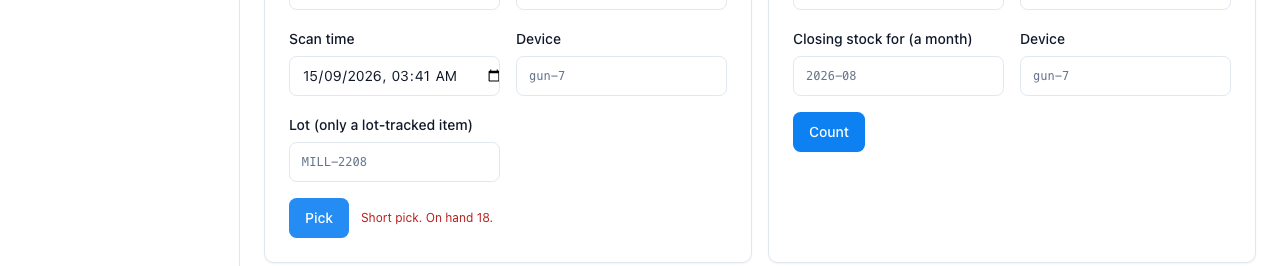
A short pick refuses and nothing moves. The short itself is still written down.
A count is a photo. The bin only moves when a second named person stamps the difference.
You should see: "Short pick. On hand 18." and a count difference waiting for a second person.
Why it matters: two things happen at once and they are kept apart: the move is refused, and the fact that stock was missing is kept. A refusal must never lose information.

3.5 The till: two tenders, a shut drawer, a dead card reader14 min

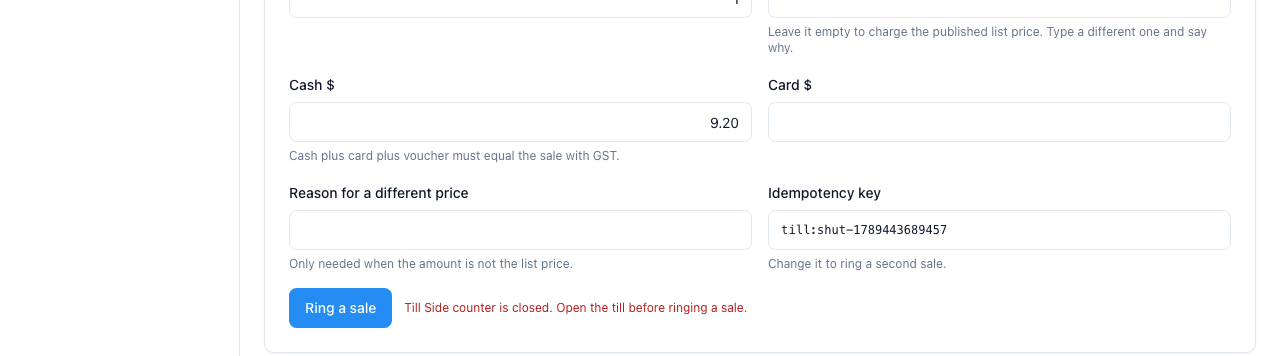
A sale at a closed till is refused by name.
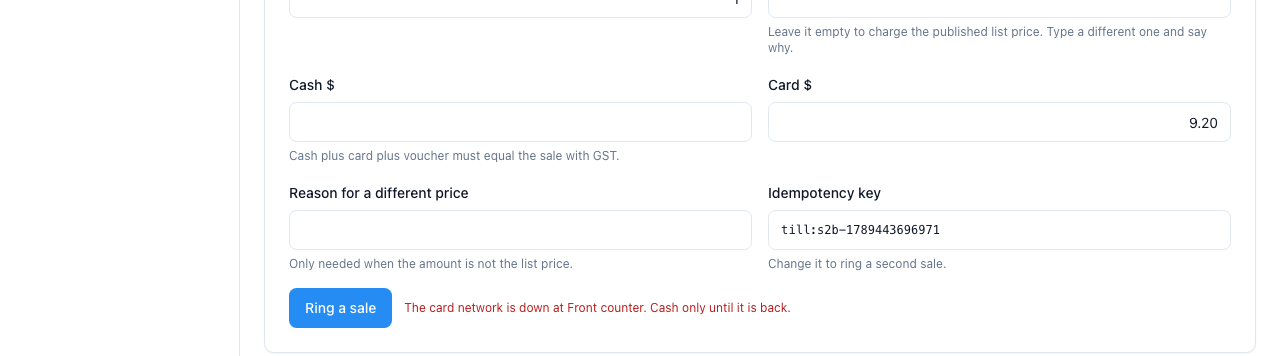
With the card network down, a card tender is refused and cash still rings.
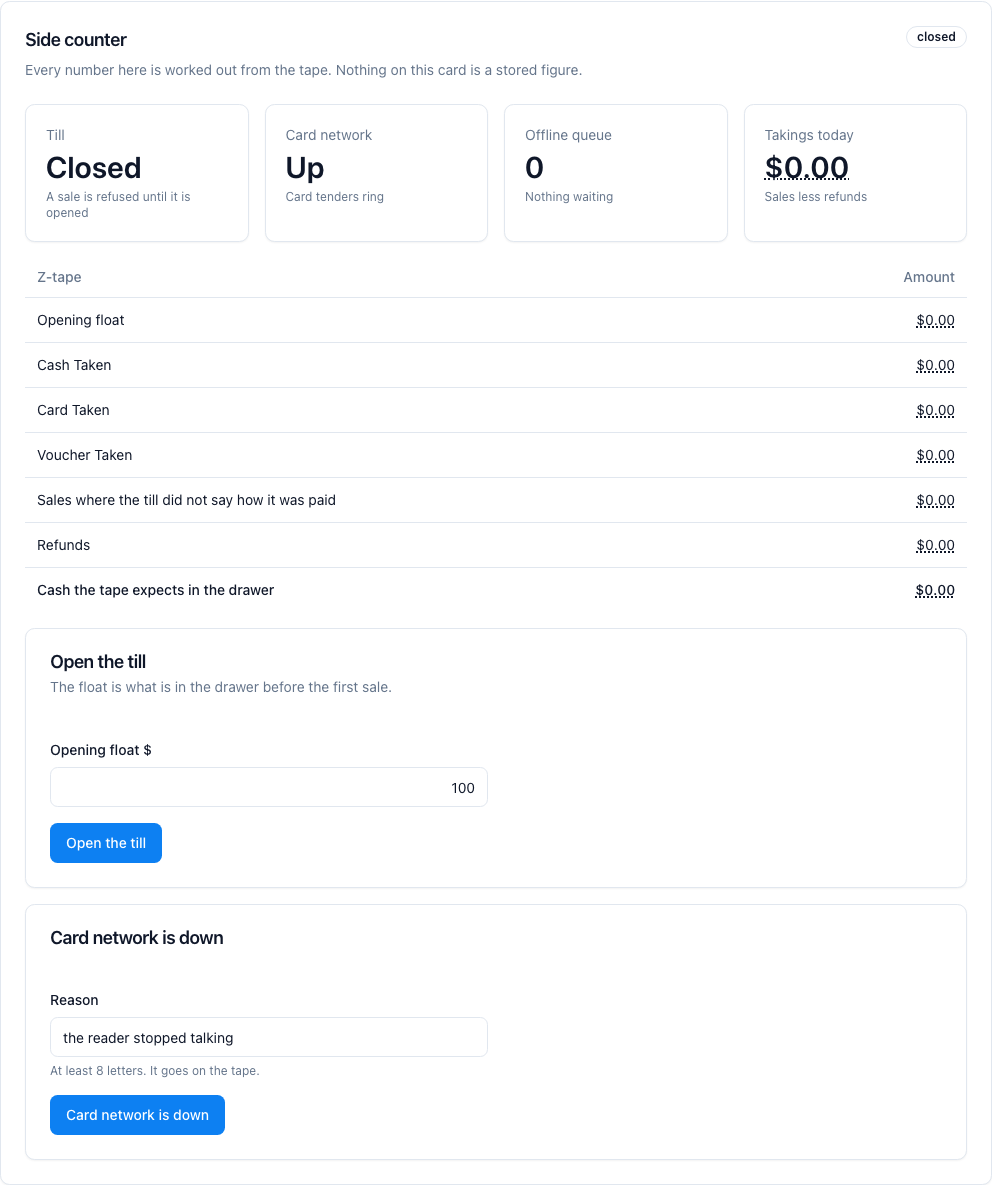
The Z-tape. Every line is worked out from the tape, not stored.
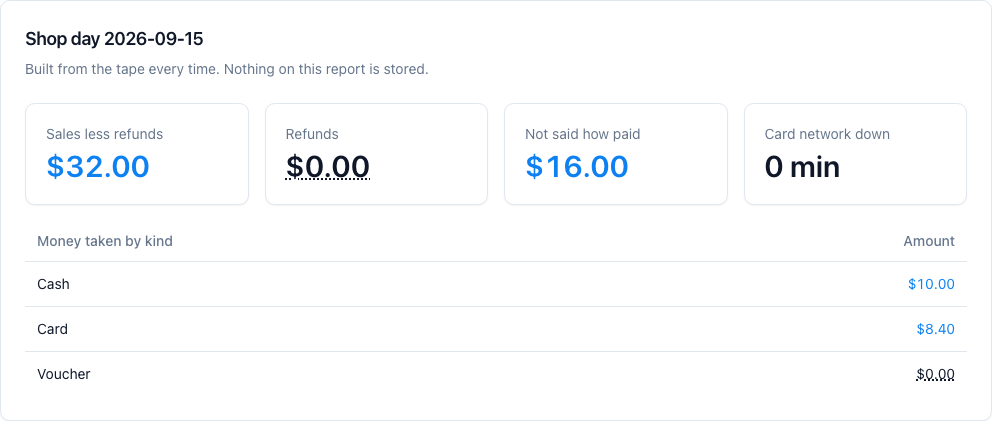
The shop day, built from the tape every time. Money taken by kind.
You should see: "Till Side counter is closed. Open the till before ringing a sale." and "The card network is down at Front counter. Cash only until it is back."
Why it matters: a till that keeps taking card money while the reader is dead makes a number nobody can settle. Saying no is the cheaper answer.

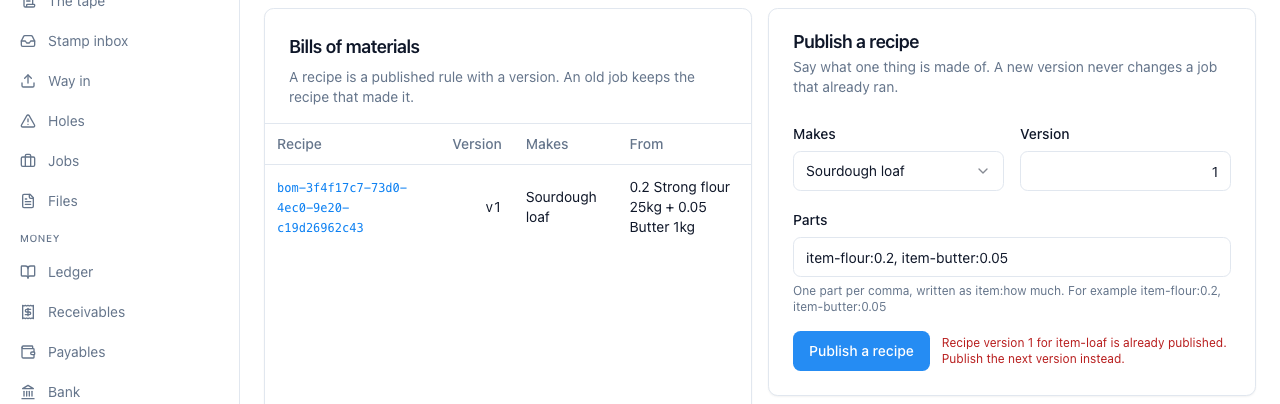
3.6 Make: a recipe is a version8 minrefusal drill

Do the wrong thing on purpose. Read the refusal, and write down the words it used.
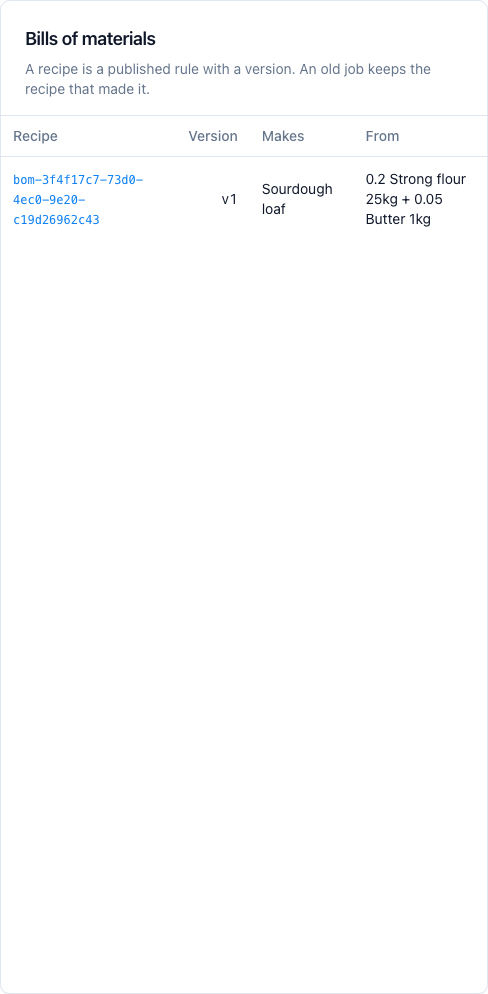
A recipe is a published rule with a version. An old job keeps the recipe that made it.
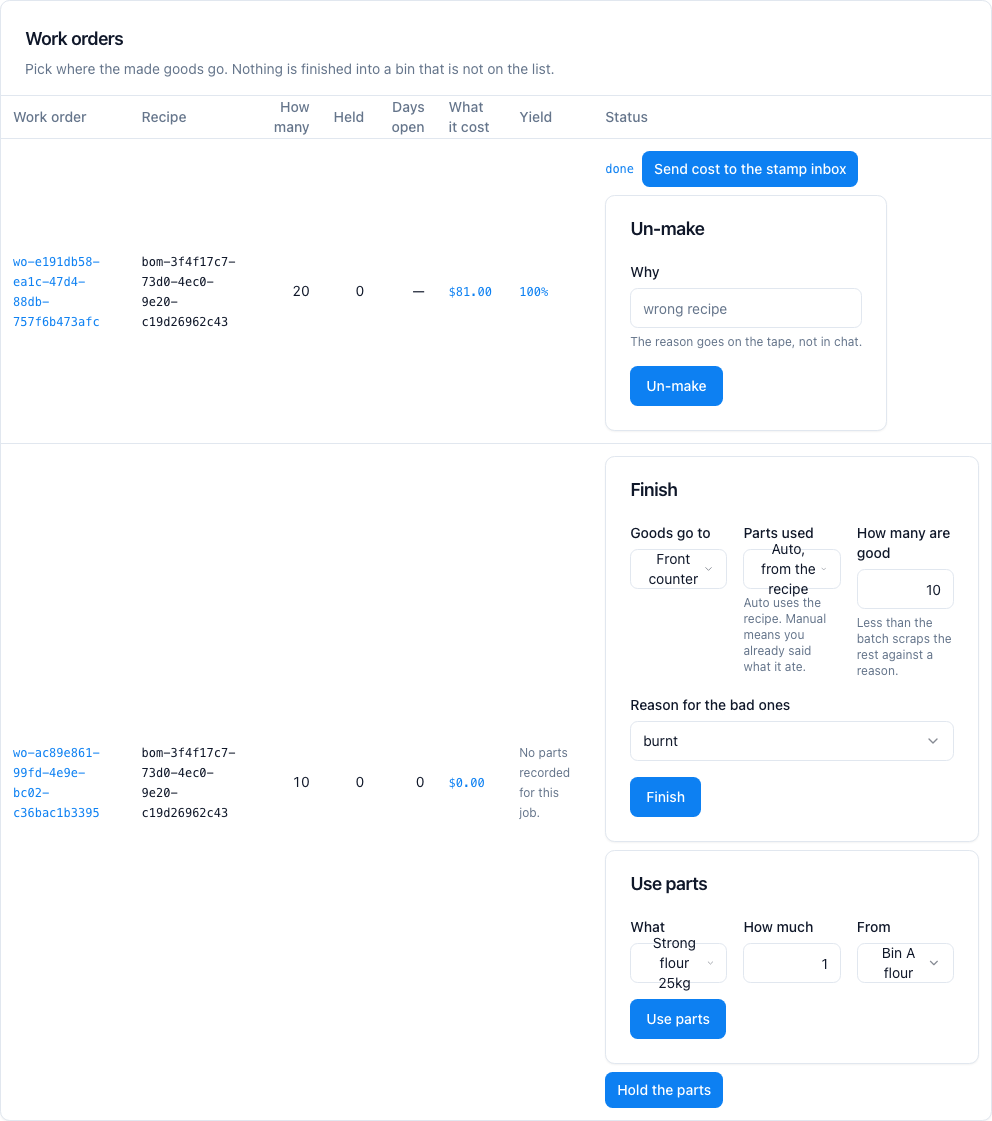
Work orders, with what they cost and their yield, worked out from the rows.
The same recipe version twice is refused. Publish the next version instead.
You should see: "Recipe version 1 for item-loaf is already published. Publish the next version instead."
Why it matters: a job that already ran keeps the recipe that made it. If a version could be changed, last month's cost could never be explained.

Check yourself

A quote, an order, a shipment and an invoice. Which one moves money?
Only the invoice, and only once a named person stamps the draft it made.
Why is "free to promise" never stored on the item?
Because it is on hand minus every live hold, worked out when you ask. A stored copy goes stale and two people sell the same stock.
Goods arrive with no purchase order. What happens?
They land on the tape, because they are real, and a ticket is opened with an owner so somebody sorts it before a bill turns up.
A pick is refused for a short. What is kept?
The short itself. Nothing moves, but the fact that stock was missing is written down so it cannot be lost with the refusal.
Is a stock count a change to the bin?
No. A count is a photo. The difference becomes a draft, and the bin only moves when a second named person stamps it.
The card reader dies. What still works at the till?
Cash. A card tender is refused by name until somebody says the network is back. Nothing flips itself.

Session 4 · People, pay and plant0/27 steps

55 minutesLog in as nia for people, pip for pay, pat for plant
Today's goal: hire someone with a real pay profile, book hours and leave, claim spend, run a pay week, and charge wear on an oven.

Nothing is guessed (3 min)

Pay is where a guess costs the most. So the shop guesses nothing: there is no default hourly rate, no default tax code, no default retirement rate. If you do not give one, the hire is refused.

Pay weeks are their own calendar. A pay week is not a month, and a pay run lands in the month its pay day falls in.

4.1 Hire someone, with the pay profile on the row12 min

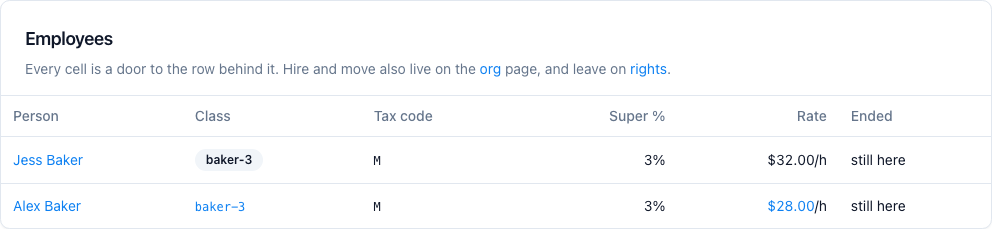
People ops. Class, tax code, retirement share and rate all ride the hire row.
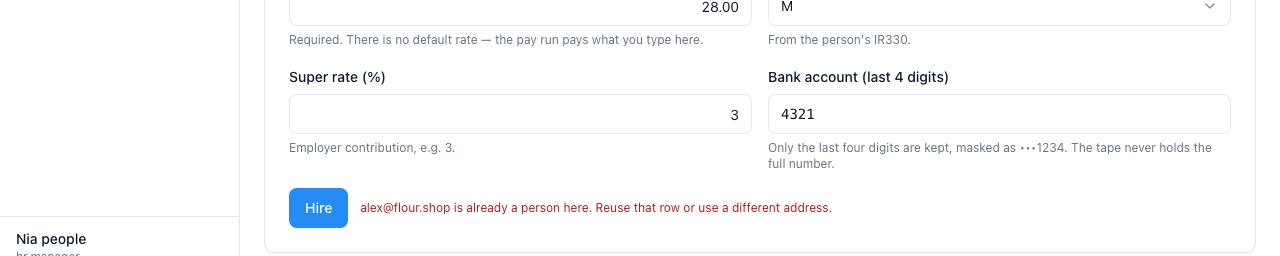
One email is one person. The second hire is refused by name.
You should see: "alex@flour.shop is already a person here. Reuse that row or use a different address."
Why it matters: one email is one person. Two rows for one person is how a shop pays somebody twice and cannot prove who is who.

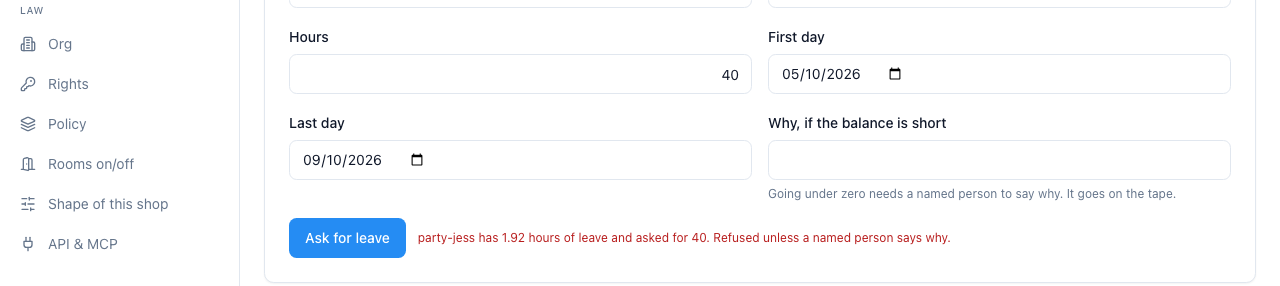
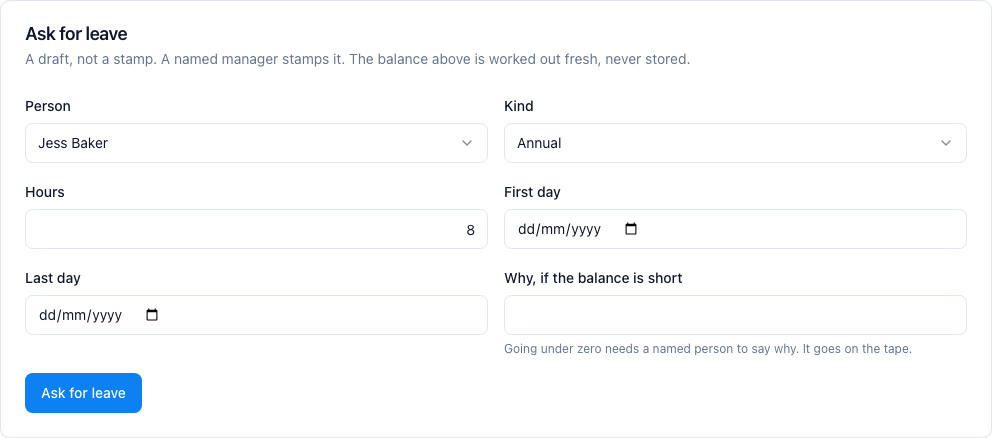
4.2 Drill: ask for leave you have not earned10 minrefusal drill

Do the wrong thing on purpose. Read the refusal, and write down the words it used.
The balance is a print. Going under zero needs a named person to say why.
Leave is a draft kind with no money. A manager stamps it.
You should see: "party-jess has 1.92 hours of leave and asked for 40. Refused unless a named person says why."
Why it matters: the balance is worked out from the rule and the rows each time. It is never a stored number that quietly drifts.

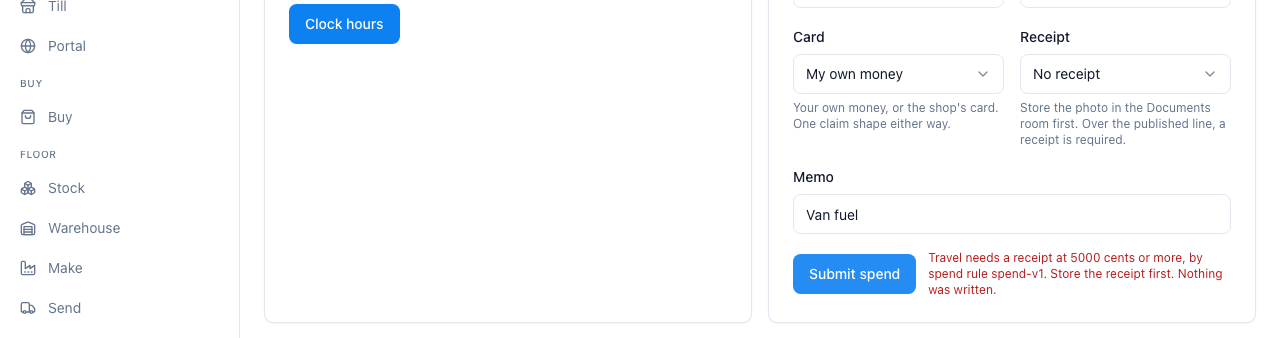
4.3 Drill: claim spend with no receipt8 minrefusal drill

Do the wrong thing on purpose. Read the refusal, and write down the words it used.

The spend rule names the amount a receipt starts being required.
You should see: "Travel needs a receipt at 5000 cents or more, by spend rule spend-v1. Store the receipt first. Nothing was written."
Why it matters: the rule is published and dated, so what counted as "needs a receipt" last March is still readable today.

4.4 Run a pay week14 min

Check before any money moves. It runs the same working the stamp runs and writes nothing.
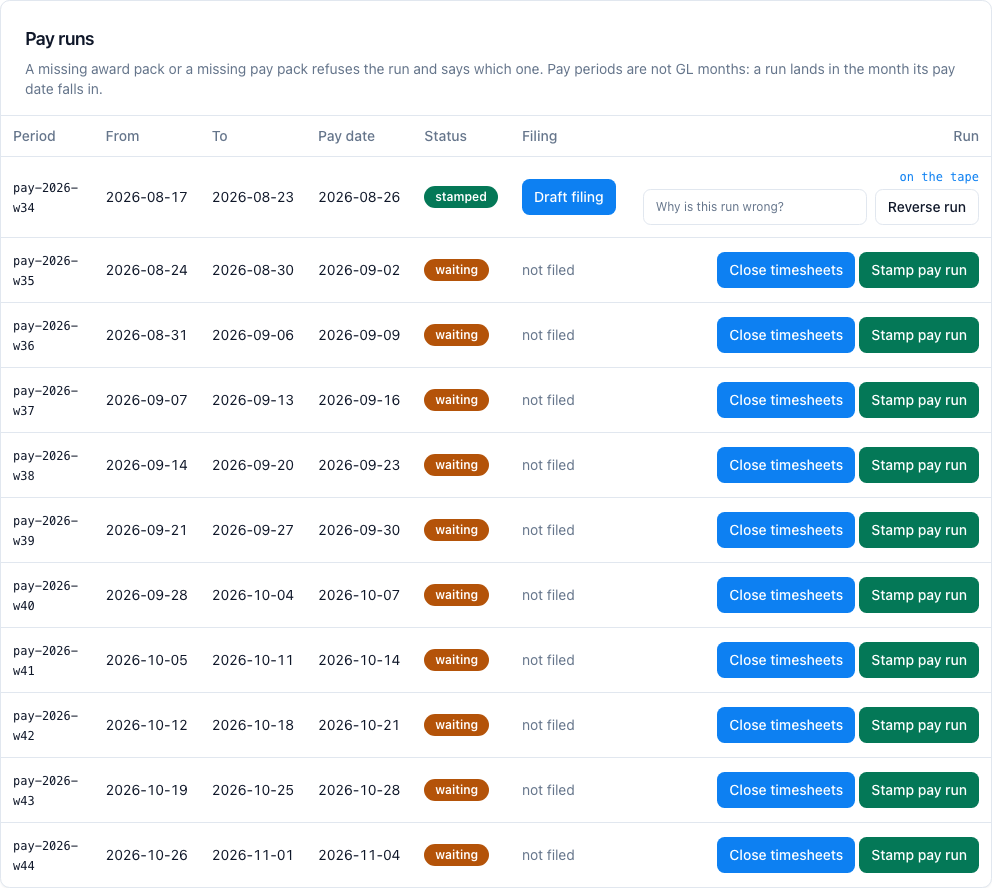
The stamped pay run in the money book.
A week nobody worked is refused, not paid as zero.
The pay week after the stamp, with its own filing state.
You should see: "No timesheets are on the tape for pay-2026-w35. Nothing to pay, the period stays open."
Why it matters: a pay run with nobody in it is a mistake, not a zero. Paying zero quietly would hide a week of lost timesheets.

4.5 Plant: wear as a draft, then sell the oven10 min

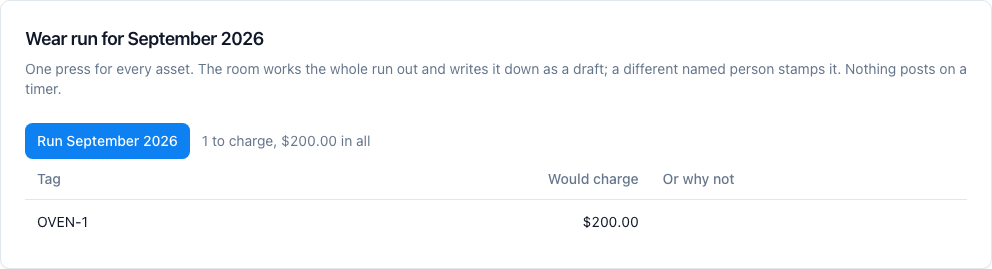
The wear run works the whole month out and drafts it. Nothing posts on a timer.
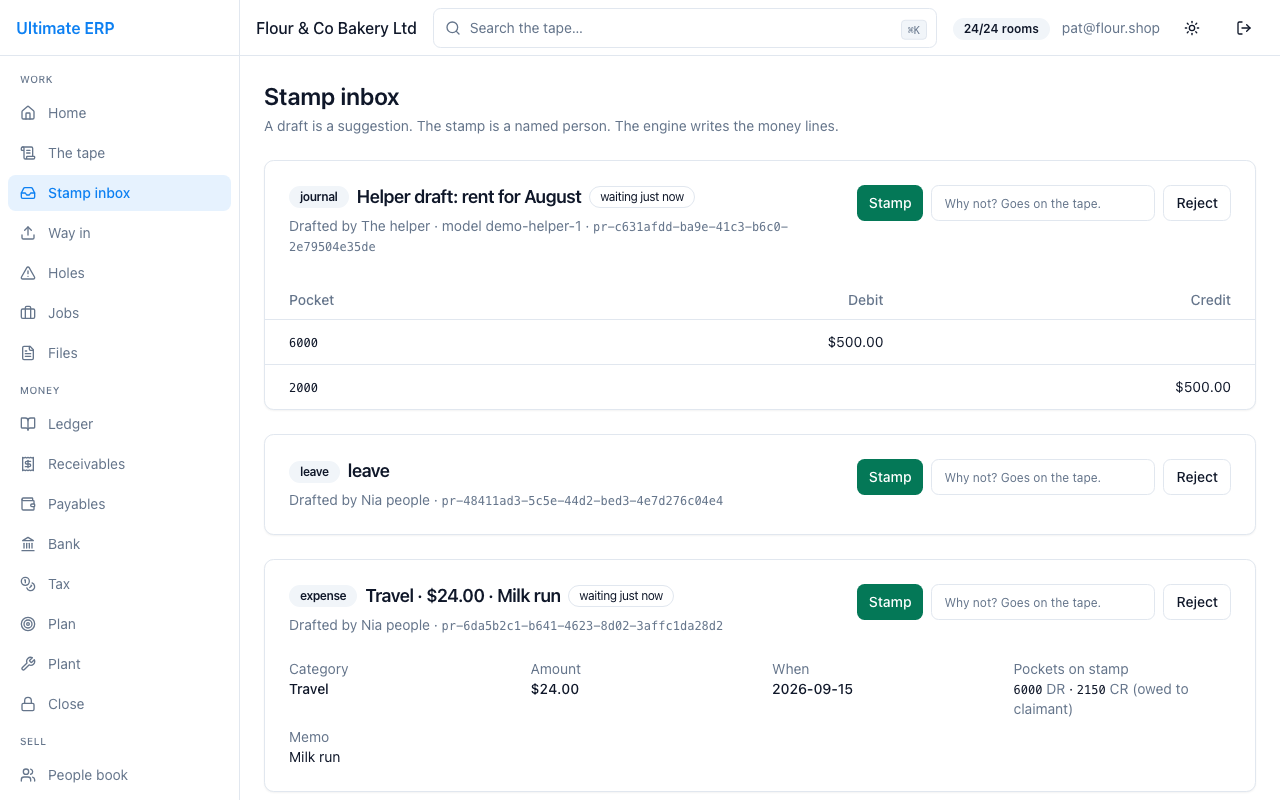
The wear run waiting in the stamp inbox for a named person.
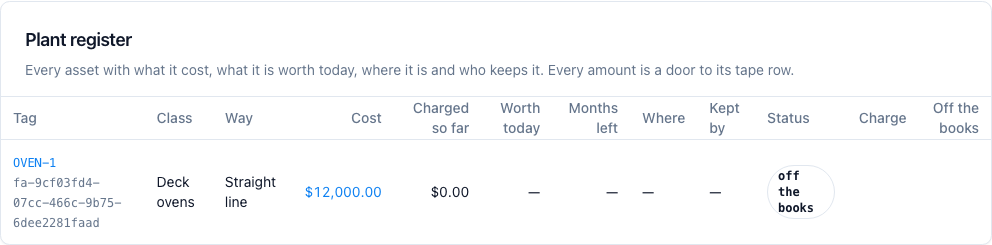
The plant register after the sale. Nothing is erased.
You should see: a wear run waiting for a stamp, and a tax book whose numbers differ from the book on purpose.
Why it matters: two sets of numbers that are both read from the same rows can never drift apart. Two stored sets always do.

Check yourself

Why is there no default hourly rate?
Because a default would be a guess about somebody's pay. The hire is refused until a person types the rate.
Is a pay week the same as a month?
No. Pay periods are their own calendar. A run lands in the month its pay day falls in.
What does the leave balance come from?
The published award rule and the rows: accrued minus taken. It is a print, never a stored number.
You claim $80 of fuel with no receipt. Why refused?
The published spend rule says Travel needs a receipt at 5000 cents or more. Nothing was written.
The wear run is a draft. Why not post it straight away?
Nothing posts on a timer. A named person stamps the month's wear, so there is always a person behind the number.
What is the tax book?
The same asset buys read again through the tax rule. It is a print: it writes no row and no money line, so the two sets can never drift.

Session 5 · The way in0/25 steps

50 minutesLog in as pat
Today's goal: bring a spreadsheet in without letting the shop guess anything, read a connector refusing by name, and find the door that has no button yet.

One rule for every way in (3 min)

A file, a paper list, a connector: all of them only draft. A named person stamps every row. Nothing arrives already true.

And nothing is guessed. If the shop does not know what a column means, it refuses the whole file and names the column.

5.1 Drill: a file with no column map10 minrefusal drill

Do the wrong thing on purpose. Read the refusal, and write down the words it used.
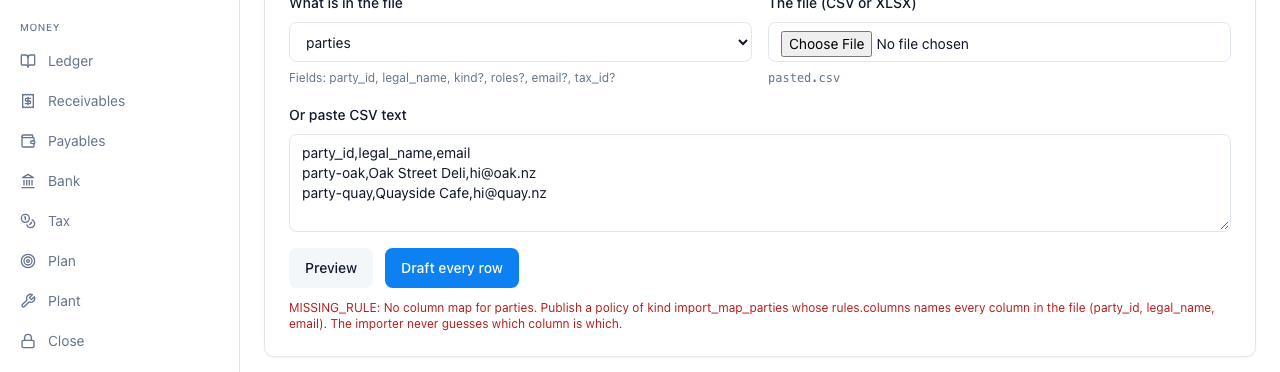
No map, no import. The refusal names the policy kind you have to publish.
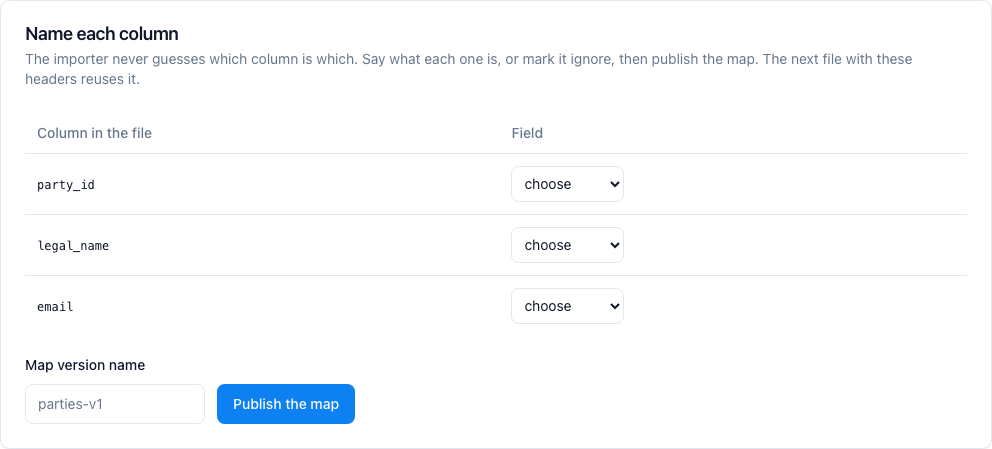
Name each column, or mark it ignore, then publish the map.
You should see: "No column map for parties. Publish a policy of kind import_map_parties... The importer never guesses which column is which."
Why it matters: a guess about which column is the email is a guess about who a customer is. The map is a published, dated rule like every other rule here.

5.2 Preview, then draft, then stamp12 min

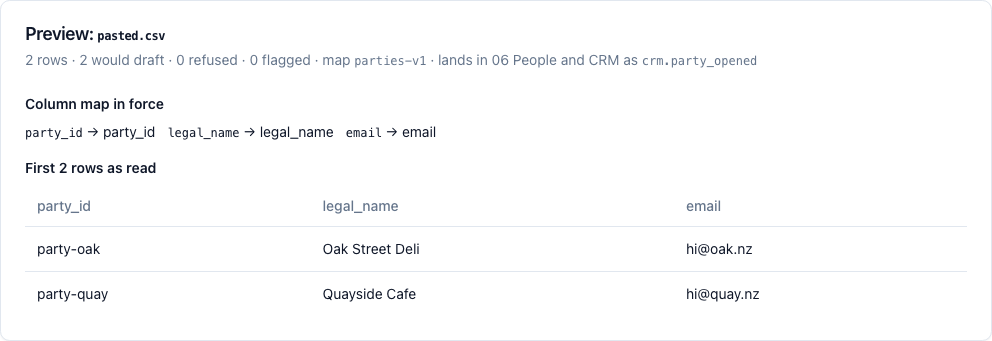
Preview writes nothing. It says how many rows would draft, how many refuse, and which map it used.
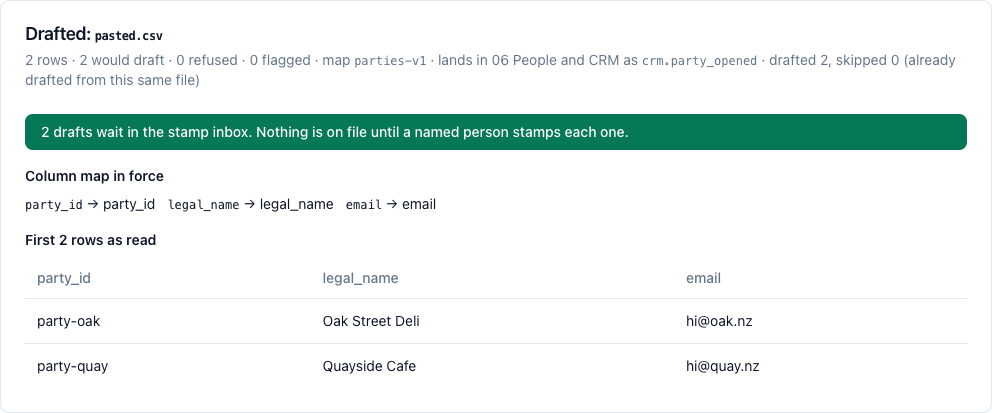
Drafted. Nothing is on file until a named person stamps each row.
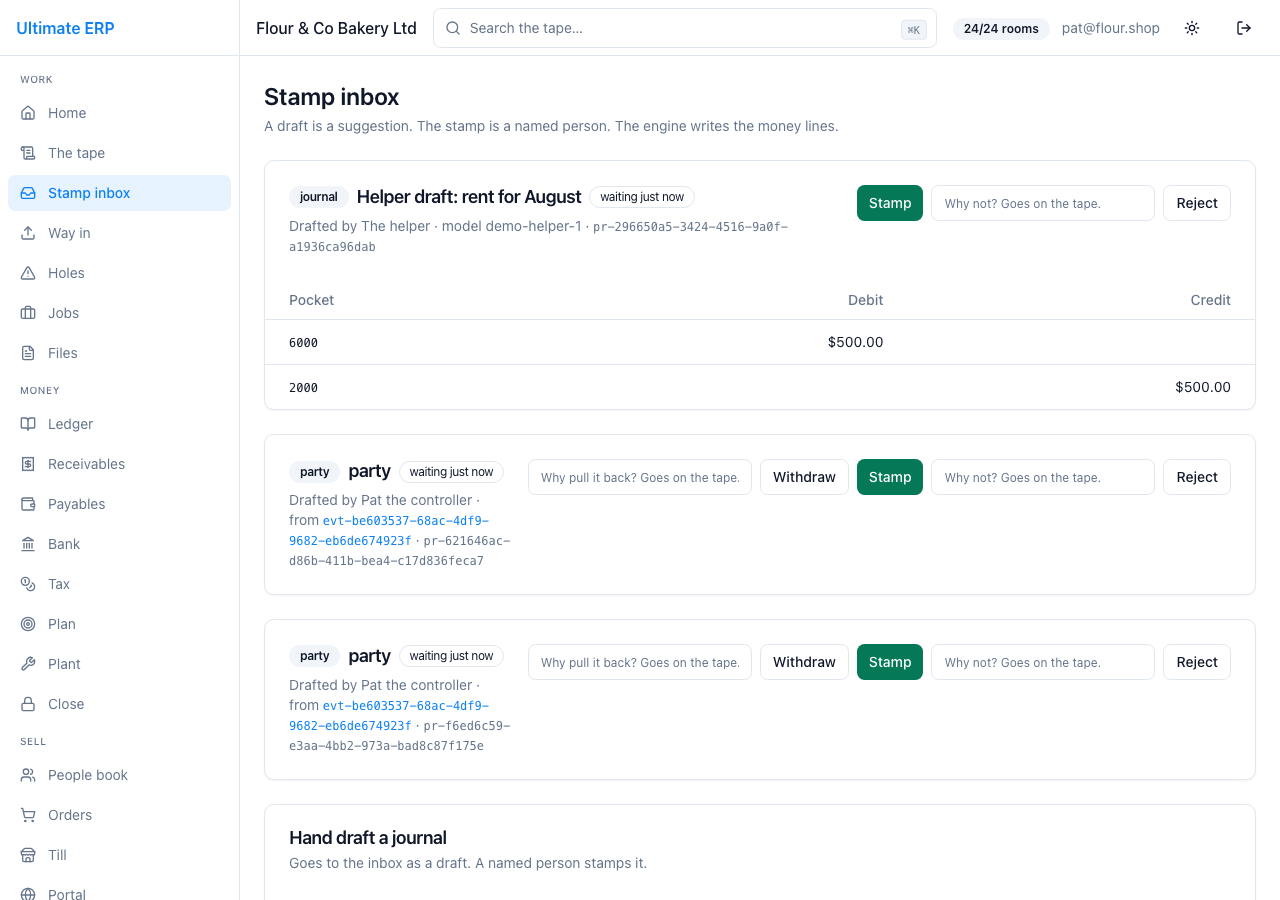
The imported rows waiting in the stamp inbox.
You should see: two drafts in the inbox, and only the one you stamped in the party table.
Why it matters: an import that writes straight into the shop is an import nobody checked. Drafts make the check the normal path, not the careful path.

5.3 Drill: the same file twice, and a column nobody named10 minrefusal drill

Do the wrong thing on purpose. Read the refusal, and write down the words it used.
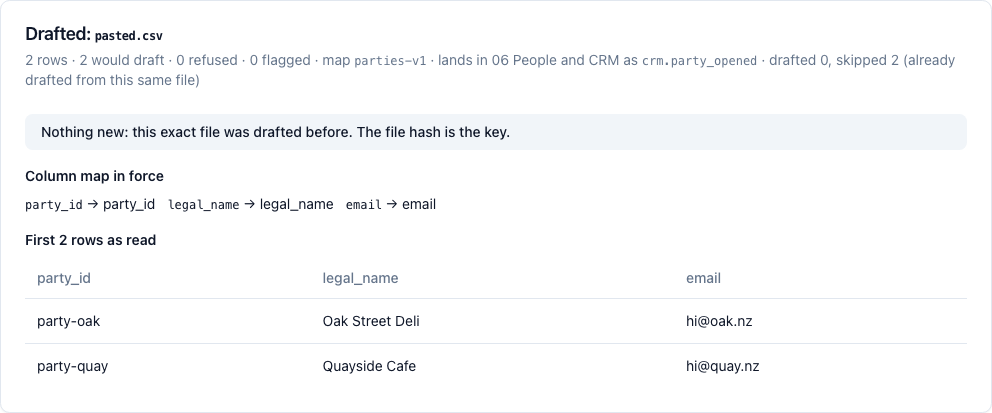
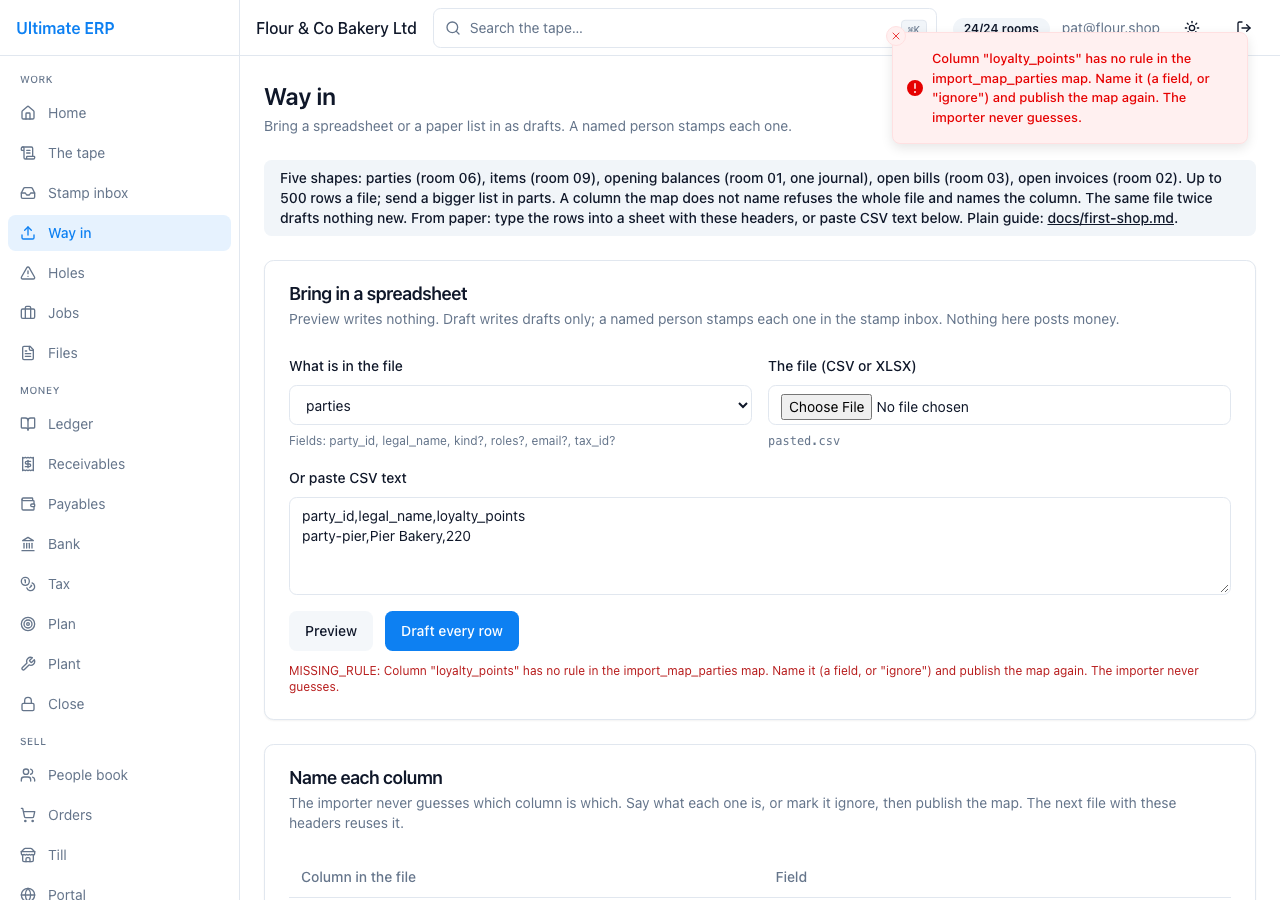
The same file again. Drafted 0, skipped 2. Nothing new was written.
One column with no rule refuses the whole file and names the column.
You should see: "Column "loyalty_points" has no rule in the import_map_parties map. Name it (a field, or "ignore") and publish the map again."
Why it matters: half an import is worse than none: you cannot tell which half is real. The file hash is the key that makes a second run safe.

5.4 A connector that refuses by name10 min

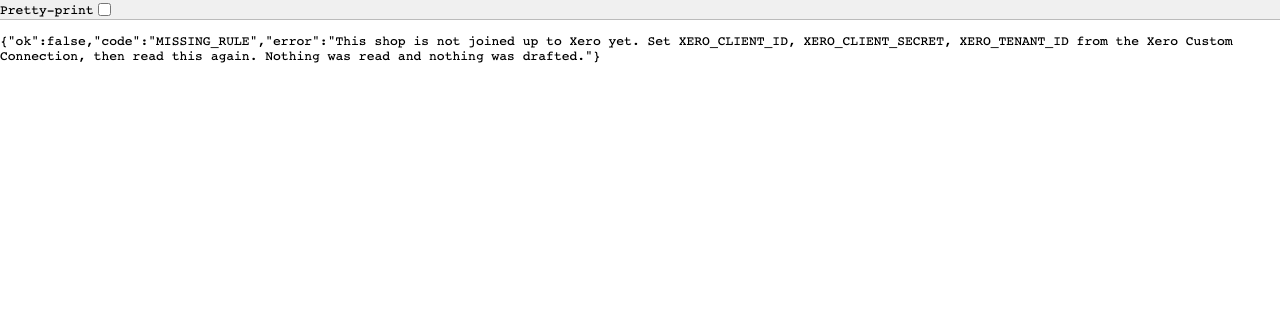
The Xero preview with no keys set. It says which settings are missing and that nothing was read.
Country packs. Rates live on versioned rules, and a missing pack refuses the bill.
You should see: "This shop is not joined up to Xero yet. Set XERO_CLIENT_ID, XERO_CLIENT_SECRET, XERO_TENANT_ID..."
Why it matters: a connector with no keys could have answered an empty, healthy-looking plan. Instead it says what is missing. Degrade loudly.

5.5 Undo a move, and the doors with no button8 min

undo-import on the door list. It is a real door with no screen button yet.
You should see: undo-import listed as a door, with no screen for it.
Why it matters: screens and scripts are two doors into the same brain. When a door has no button yet, the honest answer is to say so, not to pretend the job cannot be done.

Check yourself

What happens to a file whose columns have no map?
It is refused whole, and the refusal names the policy kind to publish and lists the columns it found.
An import ran. Is the data in the shop?
No. It made drafts. A named person stamps each row in the stamp inbox, and only then is anything on file.
You run the same file twice. What happens?
Nothing new. The file hash is the key: drafted 0, skipped 2.
One column in a hundred has no rule. How much lands?
None of it. Half an import is worse than none, because you cannot tell which half is real.
A connector has no keys. What does it answer?
A refusal naming the exact settings that are missing, and it says nothing was read and nothing drafted.
Is undo-import a screen button?
Not yet. It is a door on the act list that a script can call. The course says so rather than pretending.

Session 6 · The shape of this shop0/26 steps

50 minutesLog in as pat, and as the Mill portal at the end
Today's goal: learn how one build serves many shops: 24 rooms, 87 switches, published rules, and what an outsider can see.

One build, many shapes (3 min)

Every shop runs the same code. What makes two shops different is what is switched on.

A room is the big switch. Under it sit the small ones: 87 feature switches, each covering one behaviour. A switch that is off refuses its doors inside the kernel. It never just hides a button and leaves the door open.

6.1 Read the shape10 min

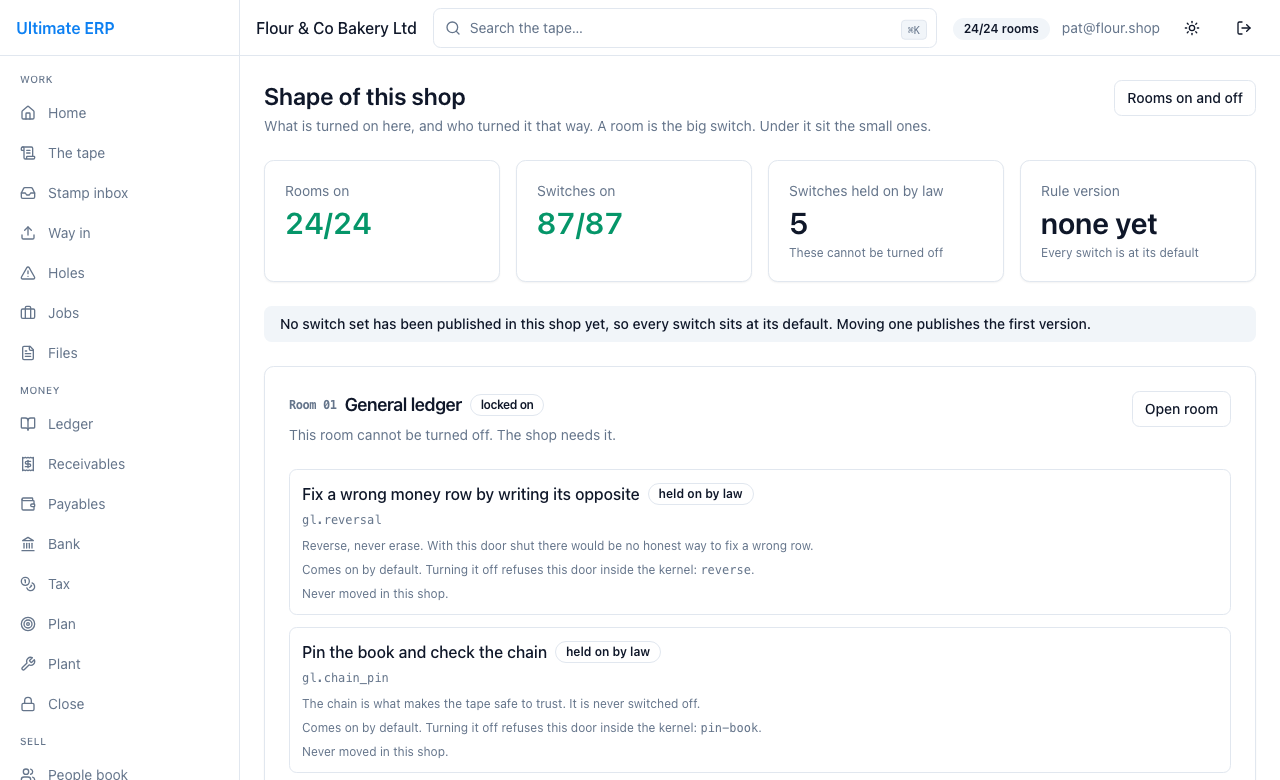
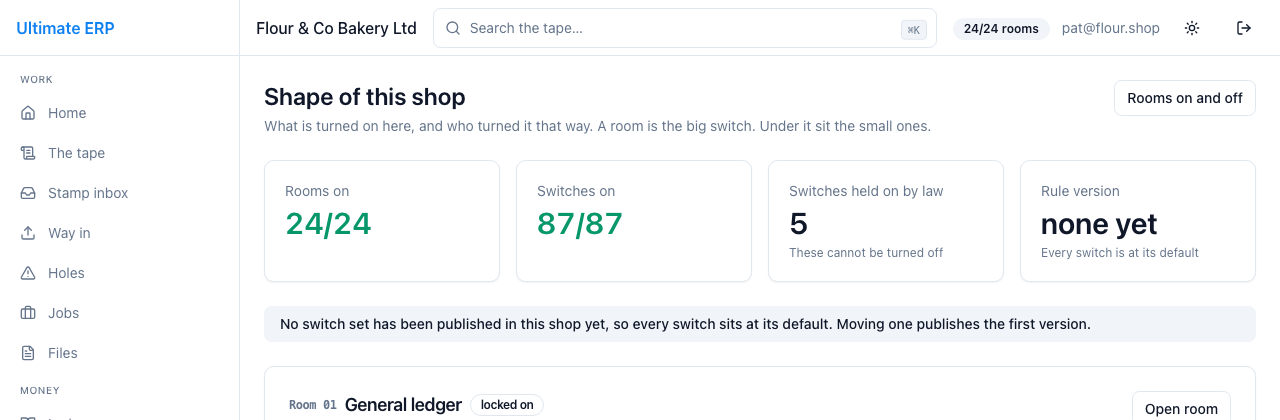
Shape of this shop. Rooms on, switches on, switches held on by law, and the rule version in force.
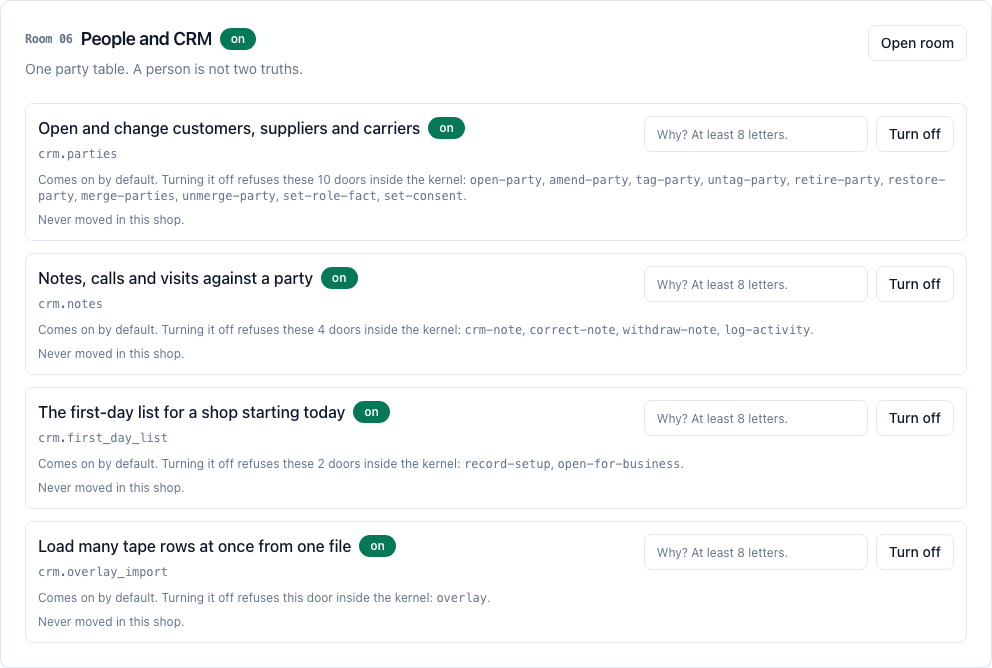
One switch: what it lets the shop do, the doors it guards, and who last moved it.
You should see: 24 of 24 rooms on, 87 of 87 switches on, 5 held on by law.
Why it matters: this page answers the question a support call always starts with: what is turned on in this shop, and who turned it that way.

6.2 Drill: flip a switch, then use the door12 minrefusal drill

Do the wrong thing on purpose. Read the refusal, and write down the words it used.
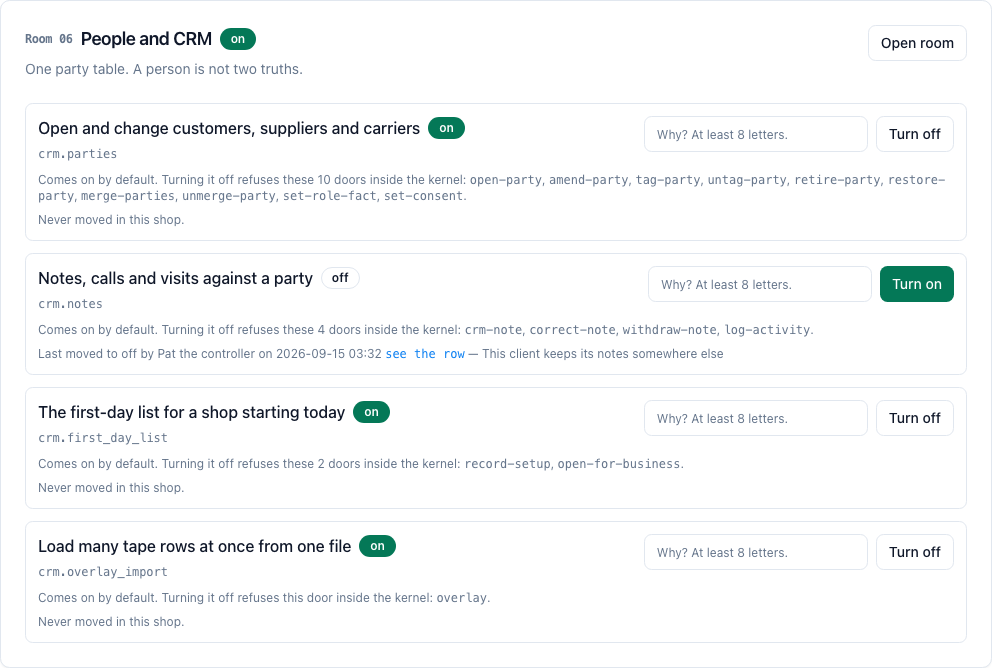
The switch is off, with the reason and the person who moved it.
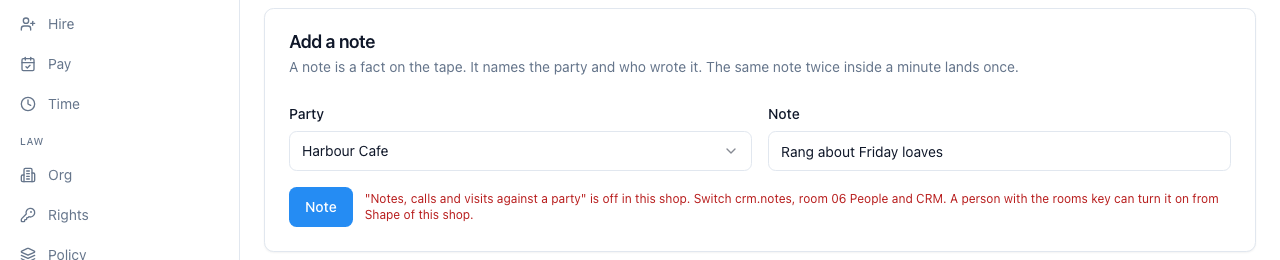
The door refuses and names the switch, its key, and the room it lives in.
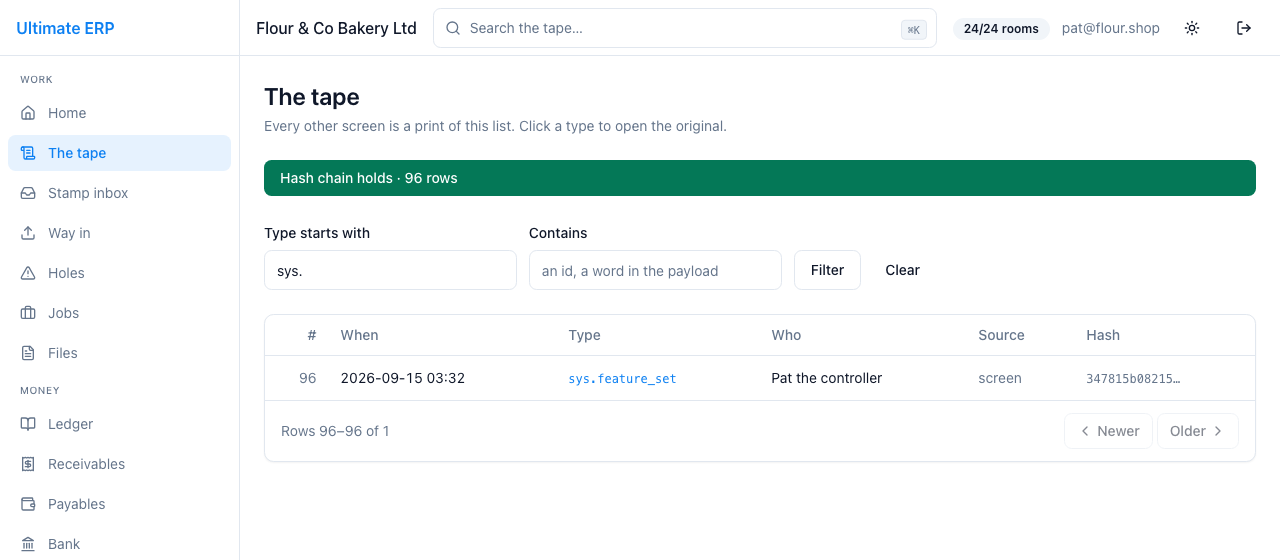
The flip as a tape row: sys.feature_set.
You should see: ""Notes, calls and visits against a party" is off in this shop. Switch crm.notes, room 06 People and CRM."
Why it matters: a hidden button is not a rule. The guard is in the kernel, so the screen, the script and the helper all get the same no.

6.3 Drill: turn a whole room off8 minrefusal drill

Do the wrong thing on purpose. Read the refusal, and write down the words it used.
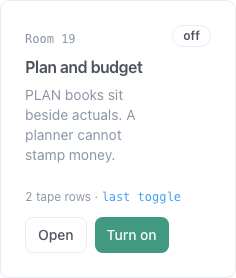
A room that is off. The tape stays and the screen hides.
The room's own page when the room is off.
You should see: the room's page saying the room is off, with its rows still counted on the rooms page.
Why it matters: off means the door refuses, not that the history is gone. A shop can turn a room back on and its old rows are all still there.

6.4 Drill: publish a rule version that already exists10 minrefusal drill

Do the wrong thing on purpose. Read the refusal, and write down the words it used.
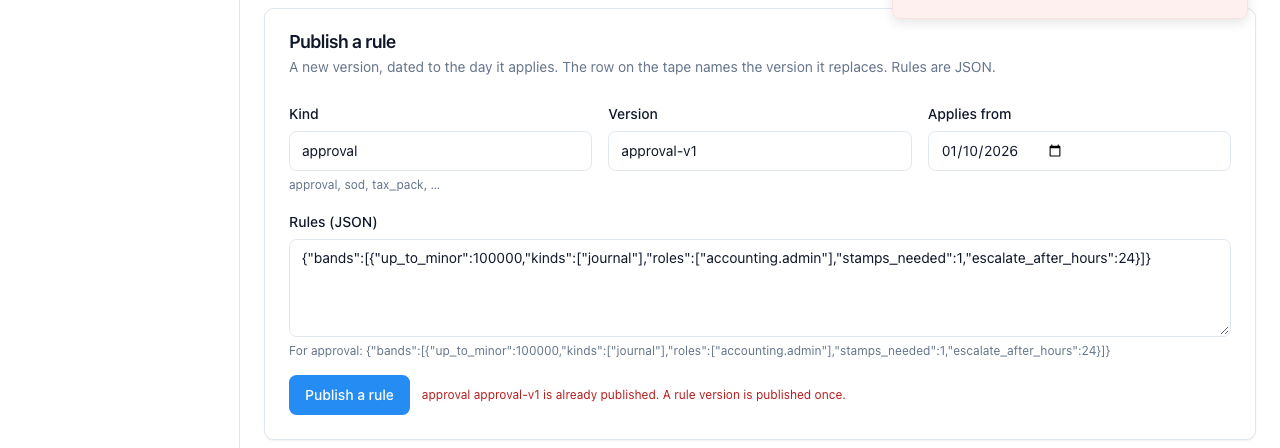
A rule version is published once. The second try is refused.
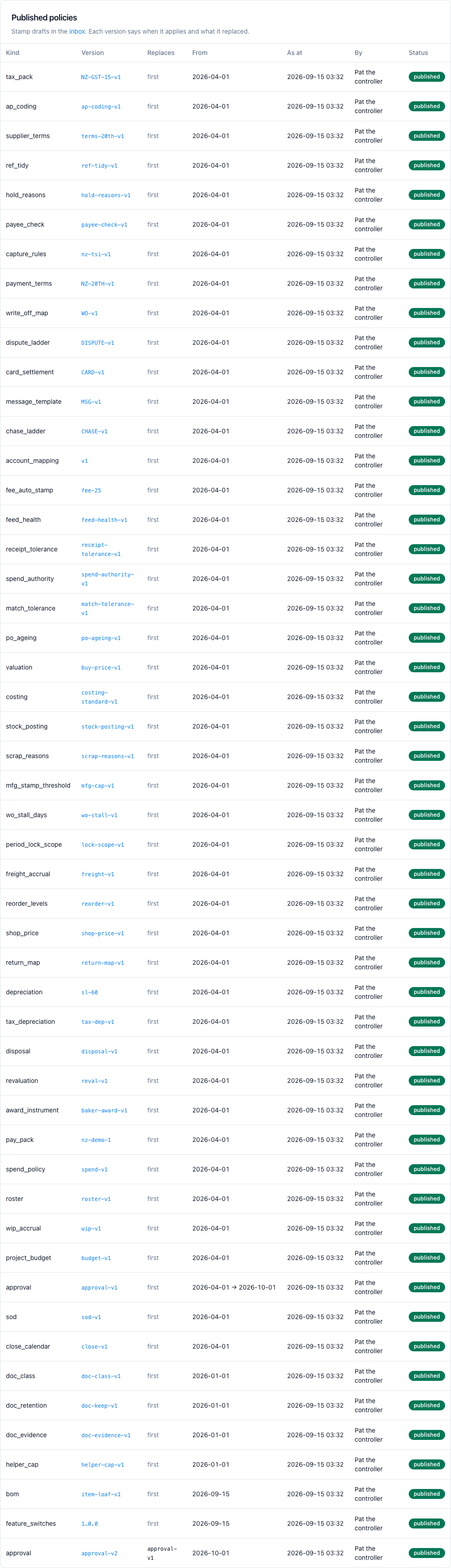
Published rules. Each version says when it applies and what it replaced.
You should see: "approval approval-v1 is already published. A rule version is published once."
Why it matters: if a version could be republished with different words, no old stamp could be explained. A change is always a new version.

6.5 What an outsider can see10 min

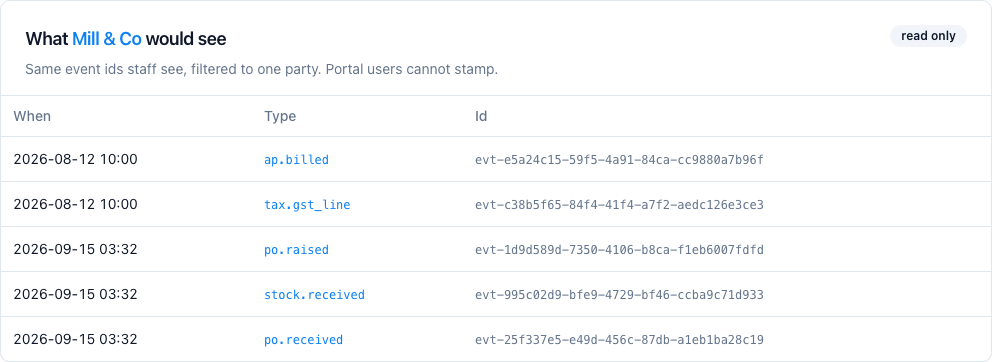
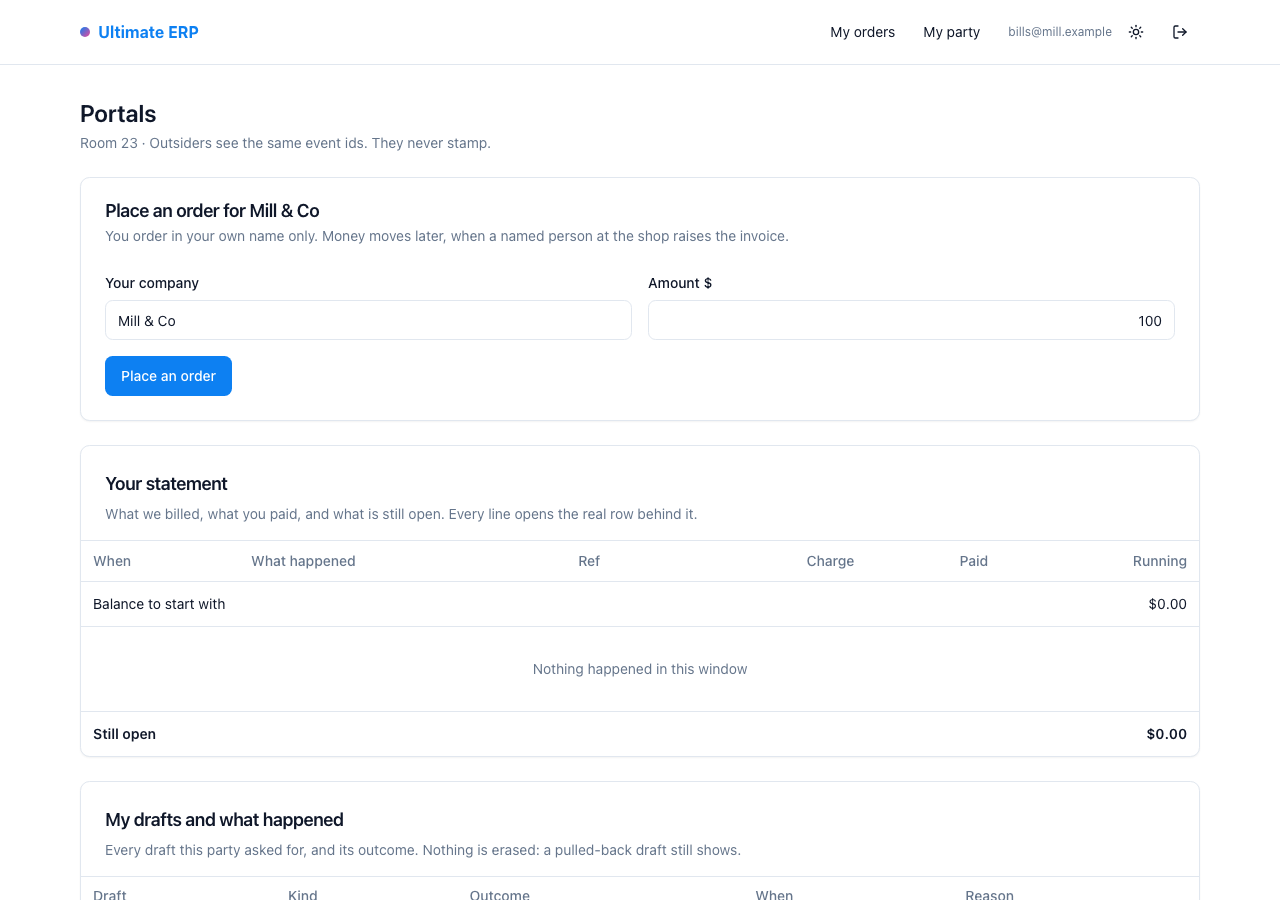
What Mill and Co would see, from the staff side.
The same shop through the portal login. Same event ids, one party only.
You should see: the same event ids on both sides, and nothing belonging to another customer on the portal side.
Why it matters: showing an outsider the same id staff see is what makes a question answerable. Showing them anything else is a leak.

Check yourself

What is the difference between a room and a feature switch?
A room is the big switch for a whole area. A feature switch is one behaviour under it. A room that is off speaks first.
A switch is off. What happens to its button?
The button may still be there, and the door refuses inside the kernel with FEATURE_OFF, naming the switch, its key and its room.
How many switches are held on by law?
Five. Each one names the house law that keeps it on, like reverse never erase, or the one money stamp.
Is a flip a rule or a setting?
A published rule. One flip is one set-feature op and one sys.feature_set tape row, so it is versioned, hashed and stamped.
You turn a room off. What happens to its old rows?
Nothing. The tape is never deleted. The screen hides and new facts for that room are refused.
Why can a rule version never be published twice?
Because an old stamp says which version it used. If the words behind a version could change, no old stamp could be explained.

Session 7 · Run the shop as the owner0/25 steps

50 minutesLog in as pat
Today's goal: learn the owner's jobs: watch the health door, work the holes, export the truth, pause the shop, and understand what a promotion is.

The owner's four questions (3 min)

Is it up? Is the chain whole? What is broken and who owns it? Can I get my data out?

Every one of those has an answer you can look at today. This session is the round you do on a Monday morning.

7.1 The health door and the holes12 min

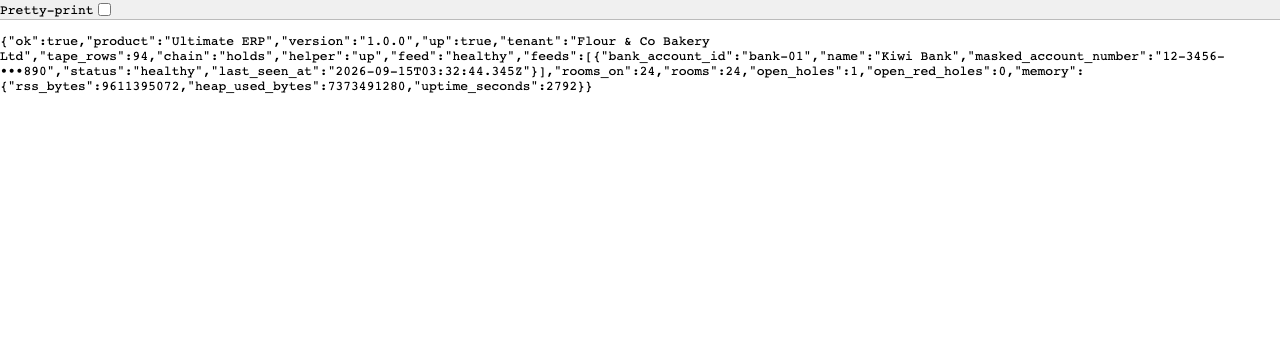
The health door, read as a named person.
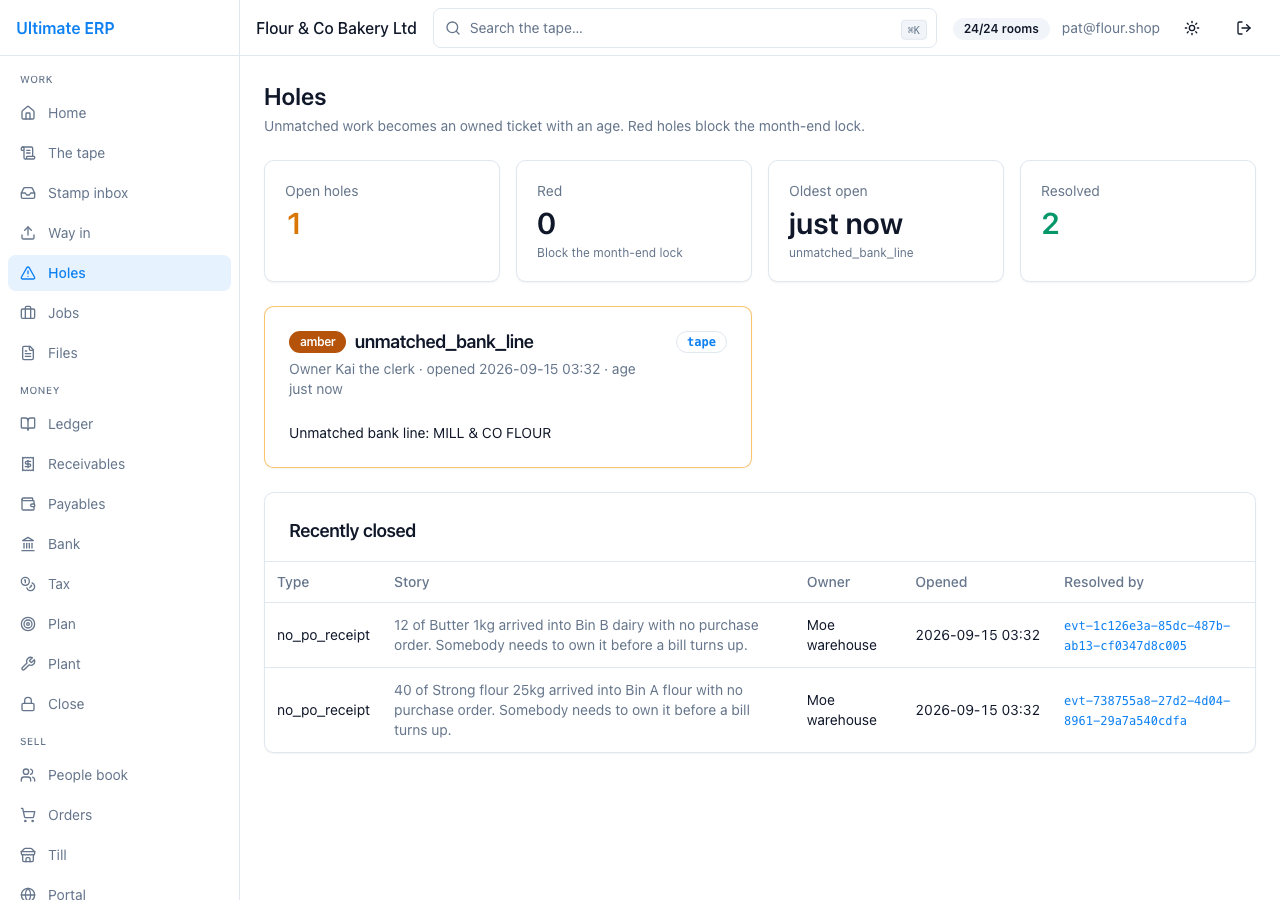
Holes. Each has a type, an owner, an age, and a door to the row behind it.
You should see: a health answer with a chain result, and a hole list where every row has a person's name on it.
Why it matters: "someone will look at it" is not an owner. Every hole has a name and an age, so nothing quietly rots.

7.2 Drill: delete the shop6 minrefusal drill

Do the wrong thing on purpose. Read the refusal, and write down the words it used.
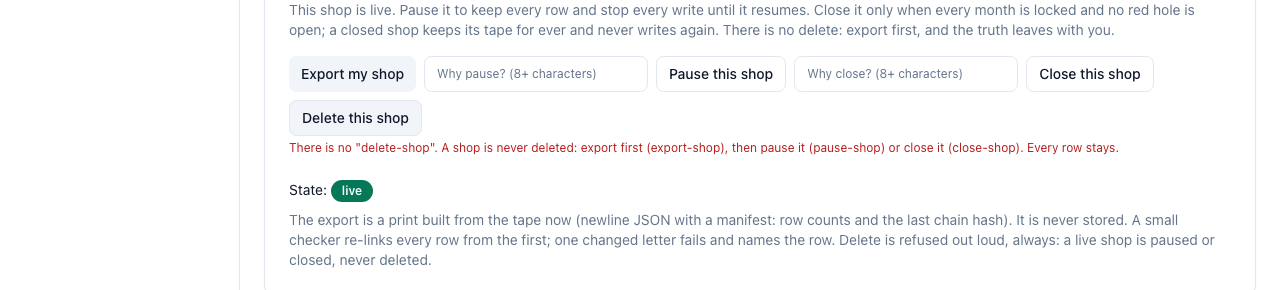
Delete is refused out loud, always.
You should see: "There is no "delete-shop". A shop is never deleted: export first (export-shop), then pause it (pause-shop) or close it (close-shop). Every row stays."
Why it matters: a delete button is a single click between a business and its history. This shop does not have one, and says so rather than hiding it.

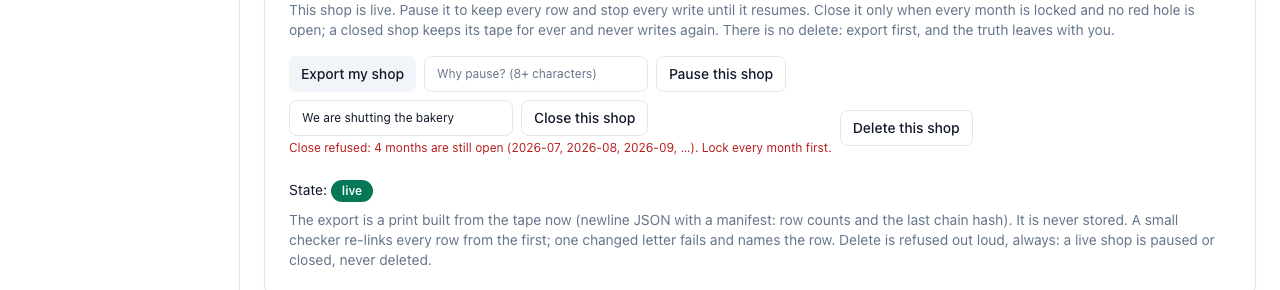
7.3 Drill: close a shop with months still open8 minrefusal drill

Do the wrong thing on purpose. Read the refusal, and write down the words it used.
Close refuses and names how many months are still open.
You should see: "Close refused: 4 months are still open (2026-07, 2026-08, 2026-09, ...). Lock every month first."
Why it matters: a closed shop can never write again. Closing one with open months would freeze a half-finished book for ever.

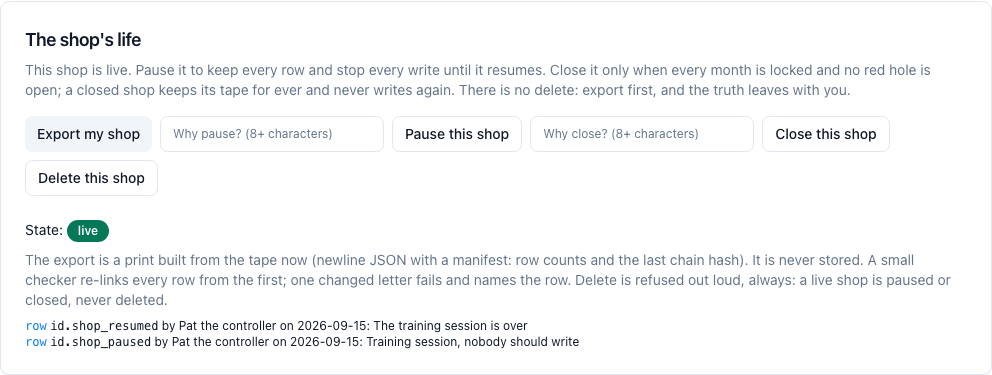
7.4 Pause the shop, and put it back10 min
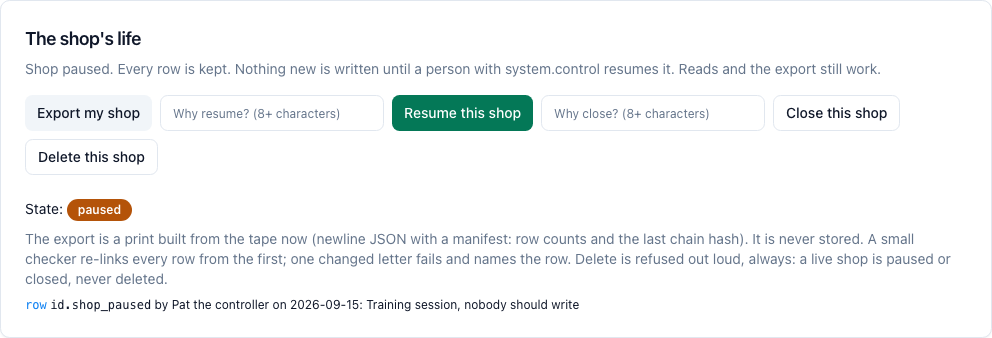
Paused. Every row is kept and nothing new is written.
The stamp inbox while the shop is paused. The controls are dead, not hidden.
Live again, with both flips on the tape below.
You should see: a paused shop where reading still works, and two rows on the tape saying who paused and who resumed.
Why it matters: pause is the honest answer to "stop everything now". It keeps every row and needs a named person and a reason to undo.

7.5 A fresh start, and what a promotion is12 min
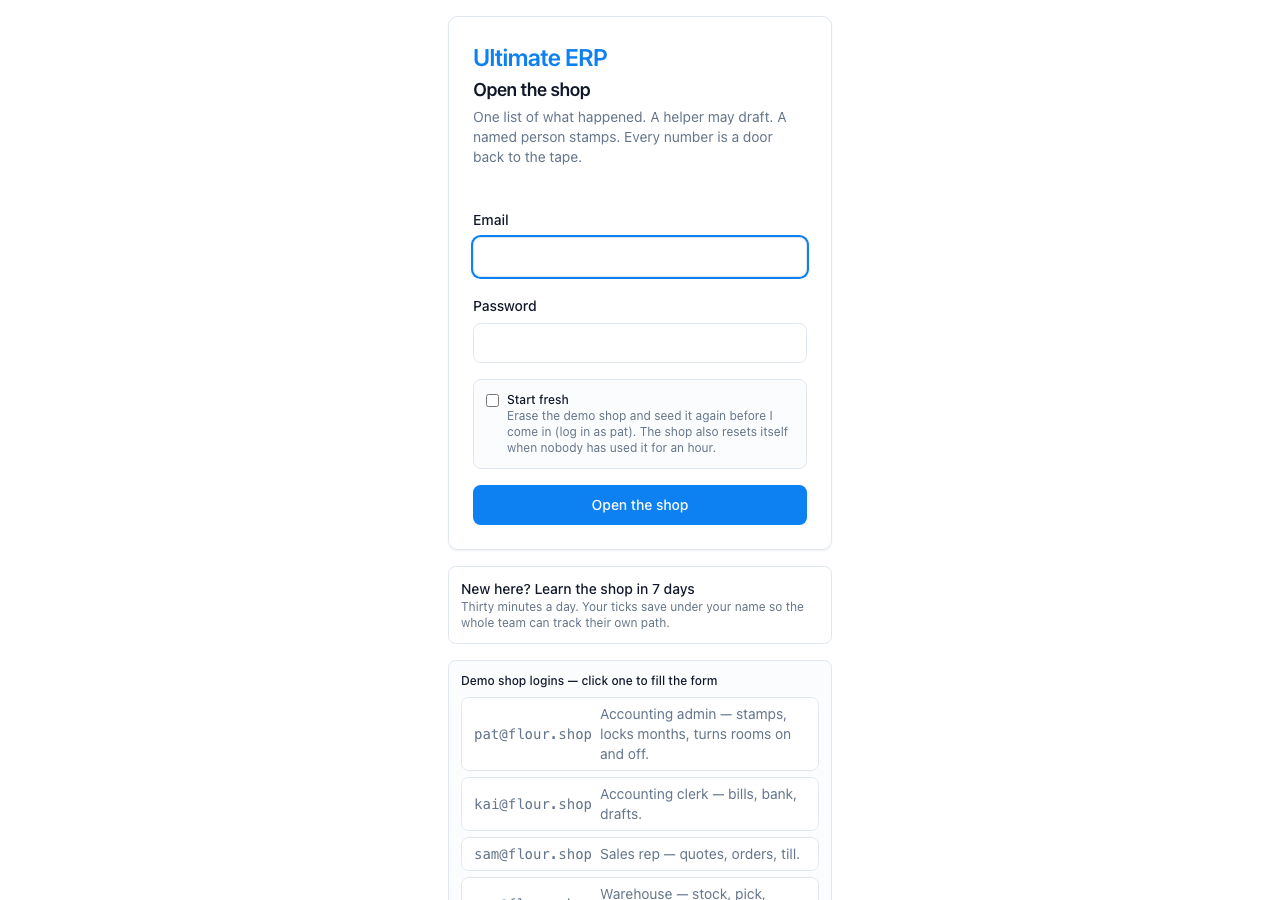
The login page. Start fresh puts the demo shop back before you log in.
The four numbers that describe a shop's shape.
The three doors: a screen, a script, and a helper. All named, all checked.
You should see: the same four numbers you could read to a support person to describe this shop exactly.
Why it matters: one build tested once, then shaped per shop by published switches. That is how one team can safely run many shops.

Check yourself

What extra does the health door tell a logged-in person?
The deep report: tape rows, open holes, open red holes, memory and the chain result. A stranger gets much less.
Which holes block a month lock?
Red ones, and any hole of a type the shop listed as blocking. Amber ones show but do not block.
How do you delete a shop?
You do not. Export it, then pause it or close it. The refusal names those three doors.
Why can you not close a shop with open months?
A closed shop never writes again, so closing with open months would freeze a half-finished book for ever.
What still works while a shop is paused?
Reading, and the export. Every write waits until a person with system.control resumes it.
What is a promotion?
The same tested build pointed at another home. The code does not change per shop; the published switches do.

If you forget everything else

Keep the four words: Happen. Draft. Stamp. Print.

And the one Stage 2 adds: a refusal is a feature. Read the words it used; they name the rule.